First order with a new supplier
When you do not yet have a reliable production-quality history for the supplier.
A quality inspection in China turns the purchase specification into checks that can be performed before final payment or shipment. China Moshaver scopes the inspection around the product, technical specification, approved sample, quantity, packaging and acceptance criteria, then records the results in a traceable report.
Inspection can reduce the risk of receiving the wrong product, visible defects, quantity discrepancies, packaging problems and selected functional failures. It does not replace laboratory testing, statutory certification, specialist testing or a 100% guarantee across every unit.
Clear information for your next decision
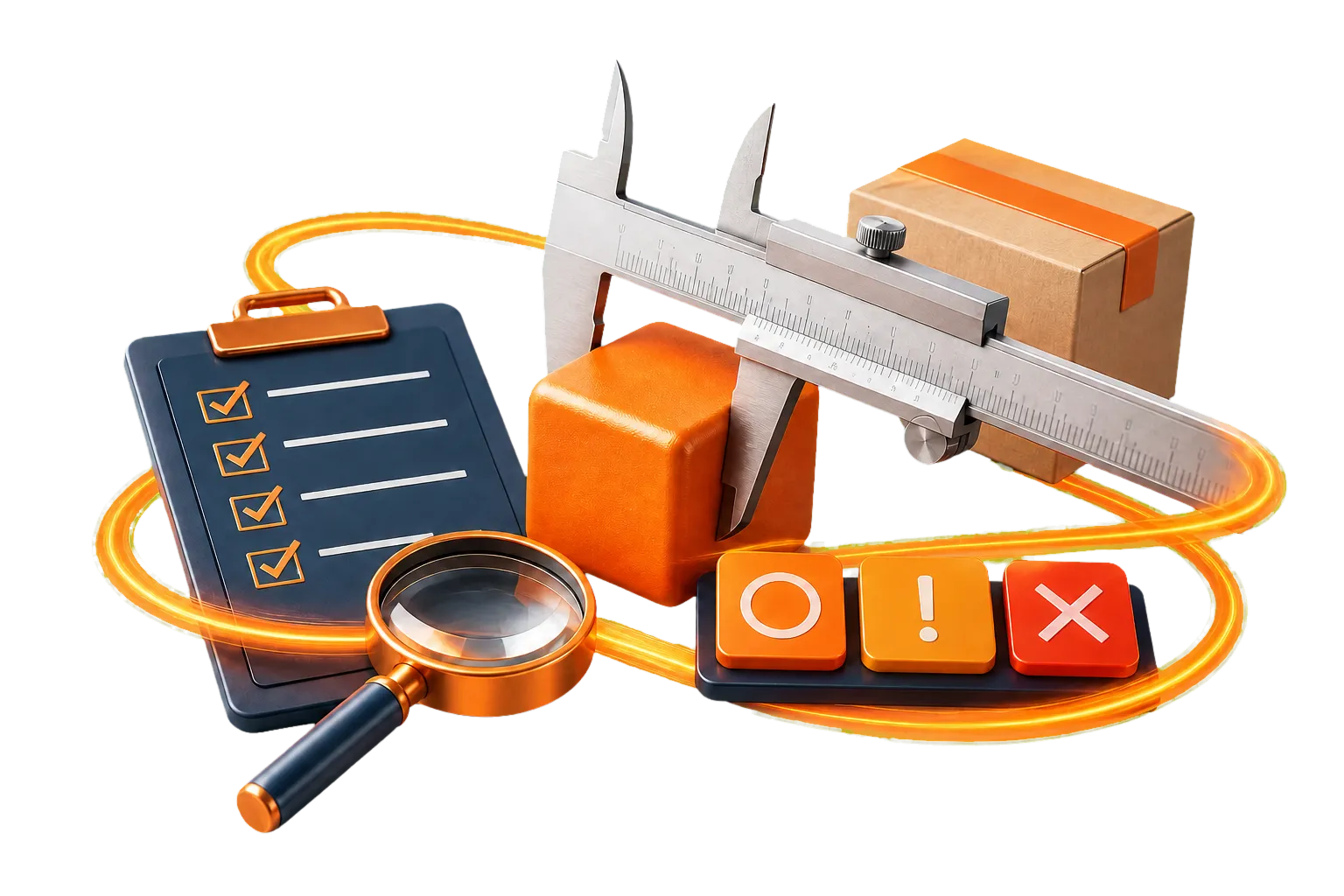
Every order needs its own inspection scope. Depending on the product and the purchase agreement, checks may cover model and SKU identity, quantity, appearance and workmanship, measurable dimensions and characteristics, on-site functional tests, accessories, labels and barcodes, inner packaging, export cartons and photographic evidence.
The buyer-supplier specification should be the primary reference. Phrases such as “good quality” or “same as the sample” are not sufficient by themselves for a repeatable inspection. Material requirements should be converted, wherever possible, into observable or measurable acceptance criteria.
When you do not yet have a reliable production-quality history for the supplier.
When colour, dimensions, logo, packaging, components or other specifications have been changed for your order.
When discovering defects after dispatch would be materially more expensive than checking before shipment.
When earlier orders had issues with quality, quantity or packaging.
When the purchase agreement makes the inspection report one input to the payment decision. Inspection does not guarantee payment safety.
To document the presented shipment before the goods move beyond the buyer’s practical control.
For orders that require the product version, material, approved sample, packaging or manufacturing instructions to be clear before production starts.
For projects where identifying a problem mid-production can prevent it from being repeated across the full order.
Checks the goods presented for shipment against agreed criteria, including sampling, quantity, workmanship, defined functions and packaging.
Checks carton condition, visible quantities, shipping marks and the loading process within a scope defined in advance.
| Inspection area | Example checks | Acceptance reference |
|---|---|---|
| Product identity | Model, SKU, colour, size and product version | Purchase Order / Specification |
| Quantity | Units, cartons and inner packs | Packing List / PO |
| Appearance and workmanship | Scratches, breakage, assembly, finish and components | Approved Sample / Defect Criteria |
| Dimensions and characteristics | Length, weight, thickness, tolerance or other measurable characteristics | Drawing / Specification |
| Function | Predefined functional tests that can be performed on site | Test Method / Acceptance Criteria |
| Accessories | Included parts, manuals, cables, tools and attachments | BOM / Packing Requirement |
| Labels and barcodes | Model, language, barcode and agreed markings | Approved Artwork |
| Packaging | Inner pack, carton, protection, carton quantity and shipping marks | Packaging Specification |
We review the product, supplier, quantity, timing and the buyer’s decision point.
The in-scope checks, explicit exclusions and required documents are set out.
The specification, approved sample, artwork and acceptance criteria are converted into an executable checklist.
The date, location, shipment readiness and access to the goods are coordinated with the factory.
Samples are selected under the agreed method, then the defined checks, measurements, tests and photographs are completed.
Results, nonconformities, evidence and limitations are reported so the buyer can decide on release, hold, rework or re-inspection.
AQL is a sampling decision tool. It should not be interpreted as a guaranteed percentage of defects in the whole lot. A sampling plan depends on inputs such as lot size, inspection method and level, defect classification and the agreed standard or procedure.
The AQL number does not decide whether a defect is Critical, Major or Minor. Those classifications must be defined from the product, use case, purchase agreement, risk and destination requirements.
For sampling methods, related standards and how to read the result, use the specialist AQL and pre-shipment inspection guide.
A defect that may relate to safety, legal requirements or serious product use, or that breaches a vital purchase condition.
A defect that materially affects function, durability, saleability or another important agreed characteristic.
A nonconformity that departs from the specification but does not usually prevent the product’s primary use.
The report should identify the scope actually performed, evidence and limitations. It should provide decision support, not merely an unexplained Pass or Fail label.
A nonconformity does not automatically cancel the order. First establish the type of defect, the number observed, its relationship to the specification and its importance to this order.
A sample inspection does not guarantee that every unit in the shipment is defect-free.
Chemical, electrical, mechanical or other specialist testing may require a suitable laboratory.
Visual or functional inspection is not a substitute for regulatory review, certification or destination-market legal requirements.
Product inspection and supplier verification are separate services with different questions and evidence.
If the goods are changed, replaced or reworked after inspection, the earlier report may not describe the final shipment.
The final cost is calculated after the scope is known. Two orders with the same unit quantity can require different budgets because of SKU count, test complexity, factory location or the time needed on site. We do not invent a universal fixed inspection price.
| Order situation | Suggested action |
|---|---|
| A new supplier whose identity or capability is not yet clear | Supplier verification before relying on production claims |
| Custom production with specification-change risk | Pre-production control + inspection |
| Production is under way and problems must be found early | During-production inspection |
| The order is ready for dispatch | Pre-shipment inspection |
| The main concern is packaging and loading | Inspection + loading supervision |
| The product needs specialist regulatory or technical testing | Inspection + qualified laboratory / compliance review |
This section shows a possible output structure only. It contains no real company, order, date, signature, measurement or inspection result.
Decision support: Release / Hold / Rework / Re-inspection — no option is selected.
The goods should be in the readiness state defined for sampling and inspection while there is still time to hold, correct or decide before shipment. The exact point depends on the product and production process.
No. Inspection—particularly sample-based inspection—reduces risk but does not guarantee zero defects across the entire shipment.
The sampling method and criteria must reflect the product, risk, supplier history and purchase conditions. An AQL number should not be used without defect classes and the other inputs to the sampling plan.
The report and evidence go to the buyer and the shipment decision can be held where necessary. The supplier may perform rework or corrective action followed by re-inspection. The buyer makes the final commercial decision.
Routine factory inspection is not laboratory testing. Chemical, electrical, safety or specialist tests need a separately defined laboratory scope when required.
At minimum, send a product link or images, specification, quantity, supplier or factory, estimated ready date and the controls that matter to you.
Supplier verification focuses on the identity, activity and counterparty risk. Product inspection focuses on the order and goods presented for checking. A new supplier may justify both.
Send the product link or specification, quantity, supplier or factory details and estimated ready date. The initial review will identify the suitable inspection type, documents and acceptance criteria for your order.
Share the product link or photo, quantity, destination country and city. Tell us which stage you need help with.
Request an initial review