
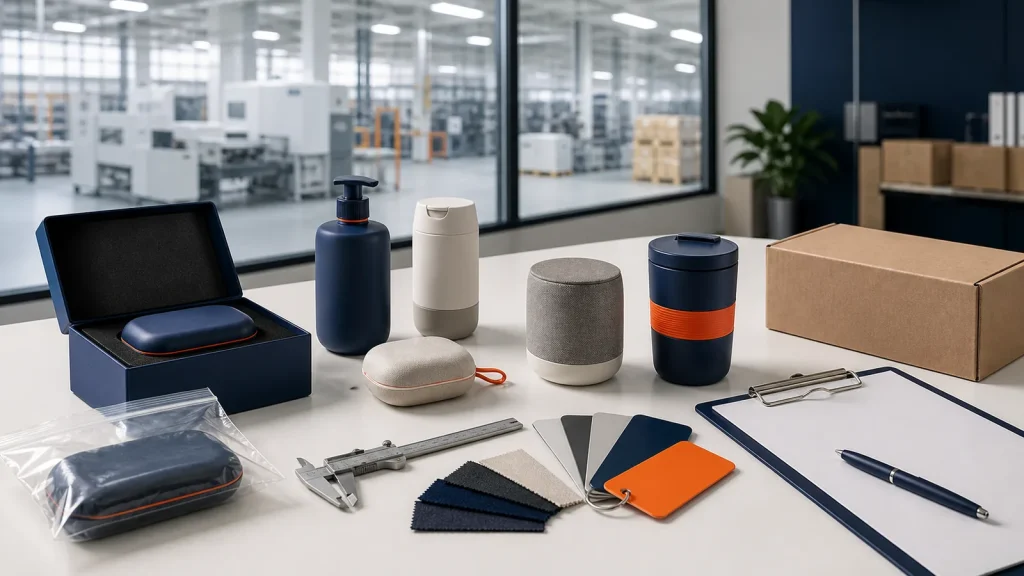
A practical buyer workflow for supplier verification, sample specifications, freight, testing, revisions, Golden Sample approval and production control.
Quick answer: treat the sample order as a small technical contract
To order product samples from China safely, verify who the supplier is, send a version-controlled specification with measurable acceptance criteria, separate the sample price from customization and freight, and record exactly what must arrive. Inspect the delivered sample against the same document: identity, dimensions, materials, workmanship, performance, accessories, packaging, and destination-market requirements. A fully approved unit should become a signed Golden Sample referenced by the purchase order and the later inspection plan. Sampling reduces uncertainty; it does not prove that mass production will automatically match. First-article checks, production controls, and pre-shipment inspection remain necessary.
Why sample approval matters before a bulk order
A catalogue image confirms very little about the unit you will eventually receive. Colour changes under different lighting, a dimension can be nominal rather than controlled, an apparently identical polymer may have different impact strength, and attractive retail packaging may fail during international transport. A physical sample converts a supplier’s sales claim into an object that your team can measure, use, stress, photograph, and compare.
The process also tests the working relationship. A competent supplier should be able to explain which factory will make the unit, whether the sample comes from stock or a dedicated run, what materials will be used in mass production, and which requested features are outside its normal process. Watch how the team handles a discrepancy. A supplier that traces the cause, proposes a controlled correction, and records a revision is demonstrating a more useful capability than one that offers vague reassurance or an immediate discount.
Sampling can expose commercial problems before a deposit locks them into a large order. The product might work but have uneconomic dimensional weight. The carton might not fit the intended shelf. The manual, plug, care label, language, or accessory set may be unsuitable for the destination market. A component may be technically acceptable yet difficult to source consistently. Discovering those facts on two units is usually more manageable than discovering them after a production lot has been packed.
First-time buyers should place the sample decision inside a complete plan for how to start importing from China, so product, supplier, payment, freight, and customs decisions remain connected.
A sample nevertheless has limits. It may be a showroom unit, a hand-finished prototype, or a piece made by senior technicians at low speed. It does not prove that ordinary production workers, regular sub-suppliers, and full line speed will reproduce it. Use it to define the target and decide whether development should continue—not as a substitute for process control.
Choose the right type of product sample
“Can you send a sample?” is too ambiguous for a reliable transaction. A supplier may interpret it as an off-the-shelf item even when the buyer expects final materials, custom colour, branding, and retail packaging. Name the sample type in the quotation, order, and approval record.
| Sample type | Best use | What it does not prove |
|---|---|---|
| Stock sample | Basic workmanship, size, function, and general factory capability | Your final colour, material batch, branding, or packaging |
| Customized sample | Logo, colour, material, feature, or packaging changes | That the same process is stable at production volume |
| Prototype | Testing a new shape, interaction, or assembly before tooling | Final texture, strength, cycle time, or unit cost |
| Pre-production sample | Approving the final design, bill of materials, finish, and pack-out | Routine output from the full production line |
| Production or first-article sample | Checking the first units made with production tools and processes | The quality distribution across the whole lot |
| Golden Sample | A controlled physical reference shared by buyer, factory, and inspector | Hidden properties that still require a specification or laboratory test |
For an unmodified catalogue item, a stock sample may be enough to eliminate unsuitable suppliers. Private-label goods normally need at least one customized sample and a final pre-production approval. Products requiring a new mould often begin with a 3D-printed, CNC, or soft-tool prototype; the buyer must record which characteristics that method can represent and which will change when the production tool is used.
Order more than one unit when the evaluation is destructive, when consistency matters, or when a reference must remain untouched. A practical arrangement is one unit for functional testing, one for cosmetic and packaging review, and one sealed reference or laboratory submission. Ask where each unit came from and whether its materials, components, firmware, tooling, and operators match the intended production route.
Verify the supplier before paying for development or samples
A low sample value does not make counterparty identity irrelevant. Obtain the company’s legal Chinese name, Unified Social Credit Code, registered address, business licence, invoice identity, and beneficiary account. The official Chinese National Enterprise Credit Information Publicity System supports searches by company name or registration code. Registration confirms a legal identity and exposes useful status information; it does not by itself prove factory ownership, export experience, engineering depth, or product quality.
Use a proportionate review. A standard stock sample may justify a licence check, video call, and payment-name match. Custom tooling, regulated products, or a large follow-on commitment warrant deeper verification. The China Moshaver guide to finding and checking a Chinese supplier explains the wider process, while supplier and factory verification can establish whether the stated facility, equipment, and operating role are credible.
Three issues deserve a pause regardless of order size: the supplier refuses to disclose its legal entity, asks for payment to an unrelated personal account without a verifiable reason, or provides conflicting information about who manufactures the product. A trading company is not automatically unsuitable; the risk comes from an undisclosed or uncontrolled supply chain.
Request product-specific evidence, not a folder of unrelated certificates. The model number, applicant, manufacturer, test date, standard, and scope should correspond to the item and market under discussion. A genuine report for a different model is not proof that your sample is compliant.

Write a sample brief that can be measured and repeated
Replace “high quality,” “same as the photo,” and “premium material” with a controlled brief. The document does not need elaborate software; it needs one owner, a date, a revision number, and enough detail for both sides to know what will be built and how the buyer will decide. Keep drawings, the bill of materials, artwork, and the brief on the same revision.
Core fields for a useful sample specification
- Identity: buyer SKU, model, revision, intended use, and destination market.
- Dimensions: measurement points, units, tolerances, weight, and fit interfaces.
- Materials: resin or metal grade, textile composition, coating, hardness, thickness, and critical sub-components.
- Colour and finish: controlled colour reference, gloss level, texture, permitted variation, and viewing conditions.
- Performance: capacity, load, speed, leakage, temperature, runtime, noise, connection, or another testable output.
- Workmanship: limits for scratches, dents, flash, seams, stitching, print registration, gaps, and contamination.
- Branding: approved vector artwork, dimensions, location, method, colour, and evidence of the right to use it.
- Packaging: retail pack, protective insert, master carton, quantities, labels, accessories, and manuals.
- Compliance: product-specific safety, labelling, documentation, and testing requirements for the destination.
- Acceptance: method, tool, conditions, threshold, and severity for every critical characteristic.
Annotate visual references. If a photograph is provided only to demonstrate colour, say so; otherwise the supplier may infer that its shape, material, and scale are also approved. Give the measurement datum for drawings. Define which file prevails if the drawing and written brief disagree. For natural materials or textiles, specify a realistic range and an approval method rather than demanding impossible visual identity.
Set acceptance criteria before the sample arrives. A useful record has four outcomes: accepted, accepted conditionally with a documented correction, revise and resubmit, or rejected. Critical safety, material, and primary-performance failures should not be offset by attractive appearance. The team should know in advance which defect stops the project.
If the specification is still immature, use China Moshaver’s China purchasing and import guides to structure the sourcing decision. Product sourcing support can also turn a commercial need into a comparable RFQ when several factories need to be screened.
Make sample quotations comparable
Ask each supplier to separate the unit sample charge, customization, artwork or printing, engineering, mould or fixture, retail packaging, domestic Chinese delivery, international freight, and any taxes or destination fees it is quoting. Record sample quantity, preparation lead time, dispatch method, packed dimensions, gross weight, and the date from which lead time begins.
Clarify whether any sample or tooling charge becomes a credit against a bulk order. A promise such as “sample refunded later” needs a minimum order, time limit, and method of credit. For tooling, identify ownership, storage location, maintenance, permitted use, the number of trial shots included, and the conditions for transferring the tool.
Require a deviation list. The supplier should state every point it cannot meet and describe the proposed alternative. This matters more than an automatic “all confirmed.” A substitute material must be identified precisely, with its effect on performance, price, compliance, and availability. Approving an unnamed “equivalent” invites later disagreement.
Questions to settle before paying
- Is this a stock, custom, prototype, or pre-production unit?
- Will mass production use the same material, component, tool, and process?
- How many revision rounds are included?
- Who owns new artwork, CAD, fixtures, and moulds?
- What is the promised dispatch date and what starts the clock?
- What happens if a measurable requirement is missed?
- Which documents and photographs will be supplied before dispatch?
- Which party arranges export, carriage, import clearance, and destination fees?
Use payment protection correctly—and understand its limits
Sample prices are often higher than production unit prices because setup, low-volume material procurement, manual work, engineering time, and print preparation are divided over very few units. The relevant comparison is not sample price alone but the total cost of reaching an approved, producible result.
When buying on Alibaba.com, the platform’s official Trade Assurance guide explains that protection is tied to an online order, its agreed quality and shipping terms, and payment through the designated route. A badge is not a substitute for a measurable specification. Put the accepted requirements, dispatch date, and evidence inside the protected order rather than relying on an external voice call.
On domestic platforms, the operating model differs. A 1688 supplier may deliver only to a Chinese warehouse and may not prepare export documents or communicate in English. The China Moshaver guide to buying from 1688 covers the practical differences. Confirm who will pay locally, receive the package, check its identity, consolidate it, and arrange compliant export.
State the named delivery place and responsibilities rather than accepting “shipping included.” ICC’s Incoterms 2020 rules allocate delivery obligations, risk, and costs between buyer and seller. They do not by themselves define product quality, transfer of title, payment remedies, intellectual property, or every customs consequence. For a courier parcel, a clear sentence about carriage, export formalities, import clearance, duties, and destination charges can prevent more confusion than an incorrectly used trade term.
Keep the quotation, approved brief, supplier confirmation, payment record, and platform order together. Verify any change of beneficiary through an independent known channel. Cross-border payment options and sanctions exposure can change; use a lawful, traceable route suitable for the parties and transaction date rather than treating a general article as current payment clearance.

Plan sample shipping, customs, and product restrictions
Courier and air freight are common for small samples because they are fast and trackable, but product characteristics can override convenience. Lithium or sodium batteries, liquids, powders, magnets, aerosols, chemicals, medical items, food, plants, and trademarked goods can require special classification, carrier approval, packaging, documentation, or permits. IATA’s Dangerous Goods Regulations address shipper responsibilities, classification, limitations, packing, marking, labelling, and documentation for air transport. Calling the parcel a “sample” does not automatically remove those duties.
Give the forwarder an accurate product description, composition, battery chemistry and configuration, capacity where relevant, quantity, net and gross weight, dimensions, actual value, and destination. Do not wait until the parcel reaches a hub to disclose a battery or liquid. For an overview of transport decisions, see how to choose air or sea freight; a development sample, however, often needs its own route independent from the eventual bulk shipment.
Customs classification depends on what the item is, not what the sender hopes it will be called. The World Customs Organization describes the Harmonized System as the international nomenclature used as the basis for tariff classification across more than 200 countries and economies. National schedules add detail and local measures. A low value or “not for resale” note is not permission to declare a fictional value. Use a truthful description, quantity, country of origin, purpose, and value, then check current destination requirements with a qualified broker or authority.
Packaging evidence to request before dispatch
- Clear photographs of the undamaged unit, accessories, open inner pack, closed carton, and shipping label.
- Actual weight and external dimensions, not a catalogue estimate.
- Protection suitable for impact, moisture, static electricity, leakage, or crushing as applicable.
- A parts list so a missing cable or insert is immediately visible.
- Separate protection for retail packaging when that packaging is itself under evaluation.
- Tracking number and handover date matched to the order.
Consolidating samples from several suppliers at a Chinese warehouse can reduce freight, but it creates a custody step. The warehouse should photograph receipt, preserve supplier identity, avoid mixing accessories, and document repacking. For high-value or sensitive development units, decide whether saving freight justifies the extra handling.
Preserve evidence when the parcel arrives
Photograph every side before opening, including dents, moisture, resealing, the carrier label, and the received weight. Video the opening for important projects and compare contents with the packing list. These records help distinguish a supplier defect from transit damage and provide a factual basis if a carrier or platform claim becomes necessary.
Assign an internal sample ID linked to supplier, tracking number, receipt date, brief revision, and evaluation owner. Do not leave visually similar units from different suppliers unlabelled on the same bench. If a test is destructive, photograph and identify the unit before and after testing so the result cannot be attached to the wrong supplier.
Use a controlled intake. One person confirms completeness and initial condition before the sample circulates among marketing, engineering, and management. Products sensitive to temperature, humidity, contamination, or ageing also need their storage conditions and time to test recorded.

Evaluate the sample with a repeatable test plan
The evaluation plan should be derived from the approved brief. For every characteristic, record method, tool, conditions, unit, threshold, result, and evidence. A dimensional result needs a defined datum and instrument. A colour decision needs controlled light and a reference. A runtime claim needs load, environment, settings, and start/stop rules. Repeatability matters because the same criteria must later guide the factory and inspector.
Five layers of sample evaluation
- Identity and completeness: correct model, revision, quantity, accessories, labels, and documents.
- Cosmetics and workmanship: colour, finish, gaps, stitching, print, flash, contamination, and assembly.
- Dimensions and materials: size, mass, thickness, composition, grade, hardness, and critical components.
- Performance and durability: real-use function, load, cycles, temperature, leakage, connection, and failure mode.
- Packaging and market fit: protection, unboxing, required information, language, and destination suitability.
Separate user testing from conformity testing. A sales team can judge appearance, handling, and unboxing. Electrical safety, chemical migration, food contact, structural load, radio performance, or a regulated product claim may require a competent independent laboratory. An internal pass should never be presented as a legal certificate.
Classify defects by impact. A critical defect threatens safety or lawful use. A major defect prevents the principal function or would cause a typical customer to reject the product. A minor defect reduces perceived quality without materially preventing use. Definitions must be product-specific: the same mark may be major on a premium visible surface and minor on a concealed industrial component.
Document each issue with a close photograph and a context photograph, sample ID, location, measurement, test condition, frequency, and the specification clause. “Quality is bad” does not tell the factory what to correct. “The latch released in all three trials below the stated load at section 4.2” creates an actionable engineering question.
End with a decision, not an impression. Accept, accept conditionally with a low-risk documented correction, revise and resubmit, or reject. A promise to fix the problem in production may be reasonable for a typographical adjustment; it is weak evidence for a material, safety, tooling, or primary-performance failure.
Control feedback and revised samples
Send a versioned corrective-action table. Each row should show current condition, expected condition, evidence, severity, responsible party, supplier cause, corrective action, and due date. Long voice messages and disconnected annotated photographs create competing versions of the truth.
Ask whether the next sample changes only the listed defects. Correcting one feature can alter weight, tooling, colour, assembly, firmware, or packaging elsewhere. Give the new sample and every updated file the same revision. Retain the previous sample until the comparison is complete.
Do not allow revisions to continue indefinitely simply because money has already been spent. After repeated rounds without measurable progress, the limitation may be process capability, material access, or engineering depth rather than communication. Compare the cost and schedule of another supplier instead of defending sunk cost.
Create and protect a Golden Sample
A Golden Sample is the physical unit formally accepted as the production reference. It should carry the buyer SKU, revision, approval date, and approver identity, with a tamper-evident seal or controlled label. Ideally, matched signed units are retained by buyer and factory. The inspector must have access to the reference or to an unambiguous controlled specification.
The physical unit does not replace drawings, the bill of materials, test methods, or regulatory requirements. Material composition, internal construction, software, and safety performance may be invisible. The purchase order should require conformance to both the named Golden Sample and the named specification revision and explain document priority if they conflict.
Control ageing and obsolescence. Adhesives, textiles, natural materials, coatings, food, and polymers can change in storage. Keep measured records and controlled photographs. When the design changes, archive the old unit as obsolete and issue a new revision; never leave two apparently valid references on the factory shelf.
Connect sample approval to mass production and inspection
A frequent failure occurs when the team approves a detailed sample but issues a purchase order containing only product name, quantity, and price. The order should identify the Golden Sample, specification revision, materials, packaging, production schedule, inspection method, defect definitions, and non-conformity remedy. A critical component or sub-supplier change should require written buyer approval.
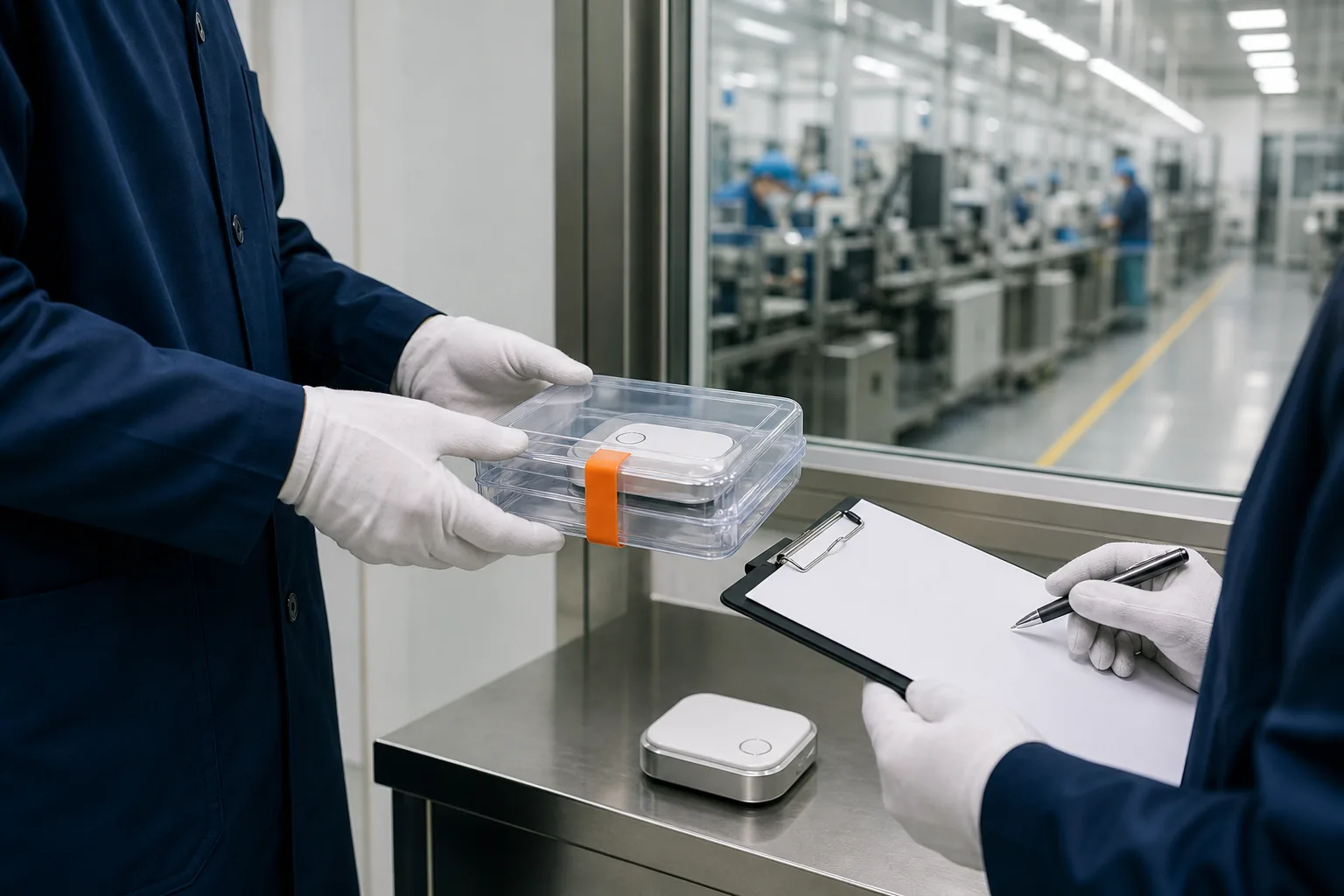
Hold a short production kick-off to close remaining questions. For a new or changed product, review first-article units made with production tooling before the entire quantity proceeds. Select in-process or pre-shipment control according to risk. China Moshaver’s inspection and quality-control service must receive the same brief and reference; “make it like the sample” is not useful if the inspector cannot see that sample.
ISO 2859-1:2026 provides AQL-indexed acceptance-sampling schemes for lot-by-lot inspection by attributes. That is not the same as ordering one development sample. The pre-production sample defines the target; acceptance sampling helps determine how many units to inspect and how lot acceptance is decided. Inspection level, AQL, and defect categories should come from product risk and contractual intent, not a universal number copied from a blog.
An excellent sample may have been made slowly by a senior technician. Normal production introduces line speed, multiple operators, incoming material lots, and sub-supplier variation. Incoming-material checks, first-article approval, in-process monitoring, final random inspection, and appropriate laboratory testing form a chain. Removing one link shifts more risk to the others.
Alibaba, 1688, and other directories: adapt the workflow, not the standard
Alibaba.com usually offers clearer export communication, online ordering, and international delivery options. Use the platform record deliberately, but still verify the legal company and manufacturing role. The China Moshaver Alibaba purchasing guide provides the broader buying context.
On 1688, domestic pricing can be attractive but the seller may only support Chinese payments, Chinese-language communication, and delivery to a domestic address. A local receiving, inspection, consolidation, and export workflow may be required. On Made-in-China and similar directories, a polished profile is still marketing evidence rather than independent proof.
Send the same controlled RFQ to shortlisted suppliers and score the responses consistently. Sample price is only one dimension. Technical accuracy, lead-time reliability, corrective-action quality, cost transparency, traceability, and supply risk often predict the long-term outcome better.
Sample-order warning signs
- The supplier will not say whether the unit is stock, customized, or production-made.
- The quotation names a different material or model from the discussion.
- Specifications are postponed until after payment.
- The beneficiary is unrelated to the contracting entity and cannot be verified.
- Product photographs appear borrowed or cannot be reproduced in a live call.
- Every compliance question receives “we have certificates” without model scope.
- Packed weight, dimensions, carrier route, or dispatch evidence is withheld.
- The response to a defect is only a discount, with no cause or correction.
- A revised sample arrives without a revision or change list.
- The supplier resists referencing the approved sample in the bulk order.
A single sign may reflect a weak process rather than fraud. Judge the pattern, the supplier’s response, and the consequence of failure. Ambiguity that is tolerable for a low-risk promotional item may be unacceptable for medical, food-contact, safety-critical, branded, or high-tooling-cost products.
Worked example: a private-label rechargeable device
Assume a buyer is sourcing a small rechargeable device with custom packaging. Three suppliers receive the same brief covering capacity, enclosure material, ports, runtime, dimensions, accessories, packaging, and destination. Each must state whether the sample uses final components and whether test reports actually cover that model.
The buyer orders two units from each supplier: one for performance and cycle testing, one for cosmetic review and retention. Sample, trial print, and freight charges are separated. Before dispatch, each supplier provides photographs of the battery configuration, pack-out, measured carton, and carrier acceptance. The buyer does not rely on “the courier always takes it” because battery carriage has product-specific conditions.
At receipt, the team records mass and dimensions, tests performance under a fixed load, compares operating temperature and runtime, and scores assembly, ports, labels, and pack protection. Supplier A looks excellent but repeatedly misses the minimum functional threshold. Supplier B performs well but the retail pack allows impact damage. Both receive evidence-based reports.
Supplier B redesigns the protective insert and sends a new pre-production unit under a new revision. It passes the repeated plan and becomes the sealed Golden Sample. The bulk purchase order names critical components, firmware revision, packaging, the reference unit, and pre-shipment inspection. First-off units are checked before the line continues, and the later random inspection applies the same functional and cosmetic definitions. The sample has become a control system rather than a souvenir.
A practical supplier-sample scorecard
| Dimension | Illustrative weight | Decision question |
|---|---|---|
| Technical and functional conformity | 30% | Did every critical requirement pass? |
| Materials and workmanship | 20% | Are the inputs and tolerances credible at scale? |
| Packaging and market fit | 10% | Will it survive transport and suit the customer? |
| Response and corrective action | 15% | Does the supplier diagnose and control change? |
| Lead time and delivery reliability | 10% | Were promises accurate and evidenced? |
| Total commercial cost | 10% | What does approval and production really cost? |
| Compliance and supply risk | 5% | Are identity, documents, and inputs traceable? |
Adjust the weights to the product. Safety-critical components require more weight on technical conformity and traceability; fashion products may emphasize colour, hand feel, packaging, and time to market. Add non-negotiable gates: a failed safety, prohibited-material, or core-function requirement cannot be compensated by a low price or attractive appearance.
End-to-end sample-order checklist
- Define the decision the sample must support.
- Name the required sample type and quantity.
- Verify the supplier’s legal identity and operating role.
- Issue a versioned brief and acceptance plan.
- Collect comparable quotations and deviation lists.
- Confirm beneficiary, platform protection, and delivery responsibilities.
- Give the forwarder a truthful product description.
- Approve packing, measured weight, and dispatch evidence.
- Document receipt and opening.
- Run the predefined test plan.
- Report defects with severity and evidence.
- Control the revised sample and all changed files.
- Seal the approved Golden Sample.
- Reference it in the purchase order and inspection plan.
Frequently asked questions about ordering samples from China
Should a Chinese supplier provide samples for free?
Not necessarily. A stock unit may be free or discounted, while the buyer pays freight. Customized, engineered, printed, or tooled samples legitimately cost more. Transparency and an agreed bulk-order credit matter more than the word “free.”
How many samples should I order?
One may be enough for a basic visual screen. Order two or three when testing is destructive, consistency must be compared, a laboratory needs a unit, or an untouched reference must be retained. Let the test plan determine quantity.
Does an approved sample guarantee mass-production quality?
No. The sample defines the approved target. Material lots, operators, line speed, tools, and sub-suppliers can vary during production. First-article control and risk-based inspection are still required.
What should I do when a sample fails?
Link the failure to the specification, record the method and evidence, request cause and corrective action, and require a revised unit for significant issues. Do not let a small discount close a safety, material, or primary-function problem.
Can a parcel avoid customs rules because it is marked “sample”?
There is no universal exemption created by that word. Classification, value, controls, and destination rules depend on the actual product and current law. Declare truthfully and obtain product-specific advice before dispatch.
Who should keep the Golden Sample?
Ideally both buyer and factory retain matched sealed units, while the inspector has access to the reference or full controlled specification. Revision, date, and identity prevent an obsolete sample from returning to production.
Is Trade Assurance enough for a sample order?
It can add transaction protection when the order and payment comply with platform rules. It does not replace a measurable brief, supplier verification, appropriate testing, or production quality control.
Sources and standards referenced
- ISO 2859-1:2026 — Sampling procedures for inspection by attributes
- ISO 28590:2017 — Introduction to the ISO 2859 series
- China National Enterprise Credit Information Publicity System — official help
- Alibaba.com — official Trade Assurance guide
- World Customs Organization — What is the Harmonized System?
- International Chamber of Commerce — what Incoterms 2020 rules do
- IATA — Dangerous Goods Regulations
Turn the sample into an auditable sourcing decision
A sample creates value when it sits inside a controlled chain: verified supplier, versioned brief, measurable acceptance, lawful transport, documented evaluation, controlled revision, and a Golden Sample tied to the contract. That chain lets a team compare suppliers on evidence and detect expensive misunderstandings before a large deposit and production run.
Next step: if you need a supplier search, sample collection and consolidation, factory verification, or a product-specific inspection plan, send China Moshaver the product details, destination market, and expected order range. The team can review the scope and propose a sourcing and risk-control route before you commit to bulk production.



[…] revision, cost, courier, declared value, destination, testing plan and ownership. The guide on ordering product samples from China explains how to compare and approve samples before a bulk order. Keep customs, battery, liquid, […]
[…] material cannot silently authorize that material for the bulk order. The detailed guide on how to order product samples from China explains how to preserve identity, comparison records and approval […]
[…] import guide hub↗Chinese supplier verification guide↗Ordering and testing product samples↗Chinese supplier purchase-contract […]
[…] full process is covered in ordering product samples from China. For a Made-in-China.com lead, add the supplier profile, product link, legal entity, and RFQ […]