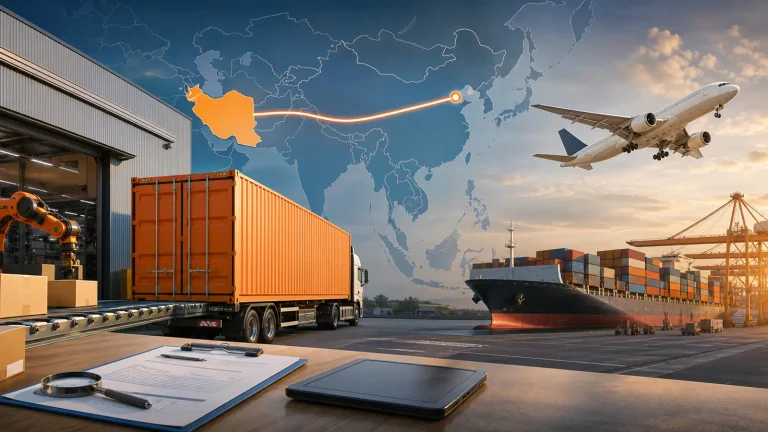
Compare chargeable weight, time, packing, restrictions and destination cost before choosing freight from China.
Air freight generally suits lighter, higher-value or urgent cargo; sea freight generally suits bulky, planned volume. The correct choice is not based on the origin rate. Compare chargeable weight, final packing, product restrictions, door-to-door time, origin and destination handling, insurance, delay risk and inventory cost in at least two complete scenarios.
“Air or sea?” cannot be answered accurately without the final packed data. A shipment with 200 kilograms of actual weight may be charged as 450 kilograms by air because of volume. A cheap ocean rate may lose its advantage after LCL handling, storage and destination fees.
This guide explains the comparison method, not a fixed rate. Capacity, season, route, cargo nature and rules change price and time. Booking decisions require final packing information and a current quotation for the actual service.
| Criterion | Air freight | Sea LCL | Sea FCL |
|---|---|---|---|
| Typical use | Urgent, light, valuable | Medium consolidated volume | High volume or more control |
| Rating basis | Actual or volumetric weight | Volume/weight and minimums | Container and route |
| Time | Shorter but variable | Longer with consolidation | Vessel schedule dependent |
| Packing risk | Volume and security limits | More handling and moisture | Stowage and lashing |
| Destination cost | Handling and clearance | CFS, storage and documents | Port, container and demurrage |
Prepare final packing data before pricing
Net product weight is not enough. Record carton count, gross weight, dimensions of every package type, stackability, pallets, dangerous-goods characteristics, batteries, liquids and commercial value. A quotation based on estimates can change after warehouse measurement.
In practice, “Prepare final packing data before pricing” is complete only when the result moves from chat messages into a traceable record. That record should state the assumptions, figures, owner of each action and the next decision date. In air or sea freight from China, a small ambiguity about the product or the division of responsibility can later become a cost, delay or quality dispute.
Execution checklist
- Prepare a preliminary packing list
- Obtain dimensions by carton type
- Declare cargo nature and restrictions
- Record value and insurance need
One freight datasheet used by every forwarder for comparable pricing.
Calculate air chargeable weight correctly
Air services commonly charge the greater of actual and volumetric weight. The divisor depends on route and service. Light, bulky packing can therefore cost far more than expected; reducing empty carton space can be more valuable than negotiating a small rate reduction.
A yes-or-no answer is not enough for “Calculate air chargeable weight correctly”. Evidence should come from an identifiable source, be checked against at least one other signal, and carry a note about its limitations. Applied to air or sea freight from China, this tells the buying team what is confirmed, what remains an assumption and which question must be closed before payment.
Execution checklist
- Measure actual gross weight
- Calculate volume for each package
- Confirm the service divisor
- Test packing optimisation
A confirmed chargeable weight and sensitivity of cost to packing changes.
Compare LCL and FCL beyond the ocean rate
LCL adds consolidation, CFS, documents, minimums and more handling. FCL includes the container, drayage, seal, free time and demurrage exposure. The economic point depends on density, ports, time and destination cost—not volume alone.
Record the decision around “Compare LCL and FCL beyond the ocean rate” in three columns: verified fact, open risk and next action. This simple format prevents important details from disappearing across messages and preserves the reasoning when a supplier, forwarder or customs adviser changes. For air or sea freight from China, that written trail is usually more valuable than a fast verbal assurance.
Execution checklist
- Itemise every LCL charge
- Obtain the complete container scenario
- Record free time and demurrage
- Assess damage and handling exposure
A door-to-door LCL/FCL comparison with exclusions and break-even conditions.
Measure door-to-door time, not transit alone
Transit time is only aircraft or vessel movement. Add supplier preparation, booking, warehouse delivery, cut-off, security, transshipment, unloading, documentation and clearance. Use a range and include likely delay in inventory planning.
The purpose of “Measure door-to-door time, not transit alone” is not to remove every uncertainty. It is to make risk visible, measurable and manageable. The depth of work for air or sea freight from China should match the order value, product sensitivity and cost of correcting a mistake. A small pilot order does not need the same controls as regulated or mass-produced goods.
Execution checklist
- Confirm cargo-ready date
- Obtain cut-off and sailing/flight schedule
- Separate origin and destination time
- Build an inventory delay buffer
A door-to-door calendar with control points and optimistic, likely and adverse ranges.
Close product restrictions before booking
Batteries, liquids, powders, magnets, chemicals, brands, radio equipment or licensed goods may limit the route and carrier. A generic product name is insufficient. Composition, MSDS, UN number, images, likely HS code and required certificates should be checked early.
After “Close product restrictions before booking”, you should be able to explain the decision to someone outside the project: why this option was selected, which alternative was rejected and what evidence supports the choice. If that explanation is difficult, the air or sea freight from China file is probably not ready for a financial commitment or a freight booking.
Execution checklist
- Give the forwarder a technical description
- Check MSDS and test requirements
- Declare brands and IP constraints
- Review destination permits
Written confirmation of transportability, required documents and service restrictions.
Match packing to the transport method
Air is sensitive to dimensions and weight; ocean exposes cargo to moisture, pressure, lashing and longer handling. Packing should protect without creating unnecessary volume. Timber, ISPM 15, corners, desiccant and markings depend on the route.
In practice, “Match packing to the transport method” is complete only when the result moves from chat messages into a traceable record. That record should state the assumptions, figures, owner of each action and the next decision date. In air or sea freight from China, a small ambiguity about the product or the division of responsibility can later become a cost, delay or quality dispute.
Execution checklist
- Run suitable drop or compression tests
- Reduce unnecessary empty space
- Check timber and pallet rules
- Photograph final packing before handover
A freight packing specification with target dimensions, protective materials and approval criteria.
Make origin and destination charges visible
“All-in” may still cover only part of the route. Separate pickup, warehouse, documents, export declaration, inspection, THC, CFS, handling, storage, delivery and tax. Ask where the rate ends, what is estimated and what triggers extra cost.
A yes-or-no answer is not enough for “Make origin and destination charges visible”. Evidence should come from an identifiable source, be checked against at least one other signal, and carry a note about its limitations. Applied to air or sea freight from China, this tells the buying team what is confirmed, what remains an assumption and which question must be closed before payment.
Execution checklist
- Write the exact start and end point
- Separate included and excluded items
- Validate destination charges locally
- Record validity and adjustment clauses
A traceable cost table with payer, currency, validity and additional-cost triggers.
Align risk, insurance and responsibility
Incoterms do not automatically create ownership or suitable insurance; they allocate delivery and cost obligations. Check insured value, exclusions, deductible, packing warranties, claim evidence and notification deadline. Insurance cannot replace sound packing and control.
Record the decision around “Align risk, insurance and responsibility” in three columns: verified fact, open risk and next action. This simple format prevents important details from disappearing across messages and preserves the reasoning when a supplier, forwarder or customs adviser changes. For air or sea freight from China, that written trail is usually more valuable than a fast verbal assurance.
Execution checklist
- Clarify the risk-transfer point
- Confirm value and scope of cover
- Obtain the claims process
- Retain pre-shipment evidence
A risk and insurance note assigning each stage and required claim documents.
Model hybrid options and make the decision
Not every order must use one mode. An urgent launch quantity can move by air while core inventory moves by sea. Compare landed cost, time, delay probability, margin and stockout cost, and keep the assumptions beside the decision.
The purpose of “Model hybrid options and make the decision” is not to remove every uncertainty. It is to make risk visible, measurable and manageable. The depth of work for air or sea freight from China should match the order value, product sensitivity and cost of correcting a mistake. A small pilot order does not need the same controls as regulated or mass-produced goods.
Execution checklist
- Build two full scenarios and a hybrid
- Include inventory and stockout cost
- Define the decision-change threshold
- Refresh rates after final packing
A freight decision note with selected scenario, fallback and pre-booking review condition.
Ten audit questions before final approval
- 01
For “Prepare final packing data before pricing”, what independent evidence exists, which assumption remains open, and who must approve the output “One freight datasheet used by every forwarder for comparable pricing.” before payment or freight booking?
- 02
For “Calculate air chargeable weight correctly”, what independent evidence exists, which assumption remains open, and who must approve the output “A confirmed chargeable weight and sensitivity of cost to packing changes.” before payment or freight booking?
- 03
For “Compare LCL and FCL beyond the ocean rate”, what independent evidence exists, which assumption remains open, and who must approve the output “A door-to-door LCL/FCL comparison with exclusions and break-even conditions.” before payment or freight booking?
- 04
For “Measure door-to-door time, not transit alone”, what independent evidence exists, which assumption remains open, and who must approve the output “A door-to-door calendar with control points and optimistic, likely and adverse ranges.” before payment or freight booking?
- 05
For “Close product restrictions before booking”, what independent evidence exists, which assumption remains open, and who must approve the output “Written confirmation of transportability, required documents and service restrictions.” before payment or freight booking?
- 06
For “Match packing to the transport method”, what independent evidence exists, which assumption remains open, and who must approve the output “A freight packing specification with target dimensions, protective materials and approval criteria.” before payment or freight booking?
- 07
For “Make origin and destination charges visible”, what independent evidence exists, which assumption remains open, and who must approve the output “A traceable cost table with payer, currency, validity and additional-cost triggers.” before payment or freight booking?
- 08
For “Align risk, insurance and responsibility”, what independent evidence exists, which assumption remains open, and who must approve the output “A risk and insurance note assigning each stage and required claim documents.” before payment or freight booking?
- 09
For “Model hybrid options and make the decision”, what independent evidence exists, which assumption remains open, and who must approve the output “A freight decision note with selected scenario, fallback and pre-booking review condition.” before payment or freight booking?
Frequently asked questions
At what weight does sea freight become better?
There is no fixed threshold. Density, volume, LCL minimums, destination cost, value and urgency determine the answer. Compare the actual packed shipment.
How is air volumetric weight calculated?
Package volume is divided by the service divisor, and the higher of actual and volumetric weight is commonly charged. Confirm the divisor for the specific route.
Is LCL cheaper than FCL?
LCL is accessible for lower volume, but CFS and destination fees matter. FCL may become better for higher volume or sensitive cargo.
How long does sea freight from China take?
It depends on ports, service, transshipment, consolidation and destination processes. Request a door-to-door range rather than only port transit.
Is cargo insurance necessary?
It is sensible for many shipments, but cover, insured value and exclusions must be reviewed. Insurance does not replace proper packing and evidence.
When is a hybrid shipment useful?
When part of the order is urgent but moving everything by air is uneconomic. Include stockout risk and duplicate handling in the decision.
Conclusion and next step
The best freight method is not the fastest label or cheapest headline. It is the method that creates an acceptable combination of time, cost and risk across the whole business scenario. A comparison without final packing and destination charges is not ready for booking.
Before requesting rates, create one datasheet with weight, dimensions, cargo type, value, origin, destination and cargo-ready date. Collect quotations in the same format and reconfirm after final packing.