
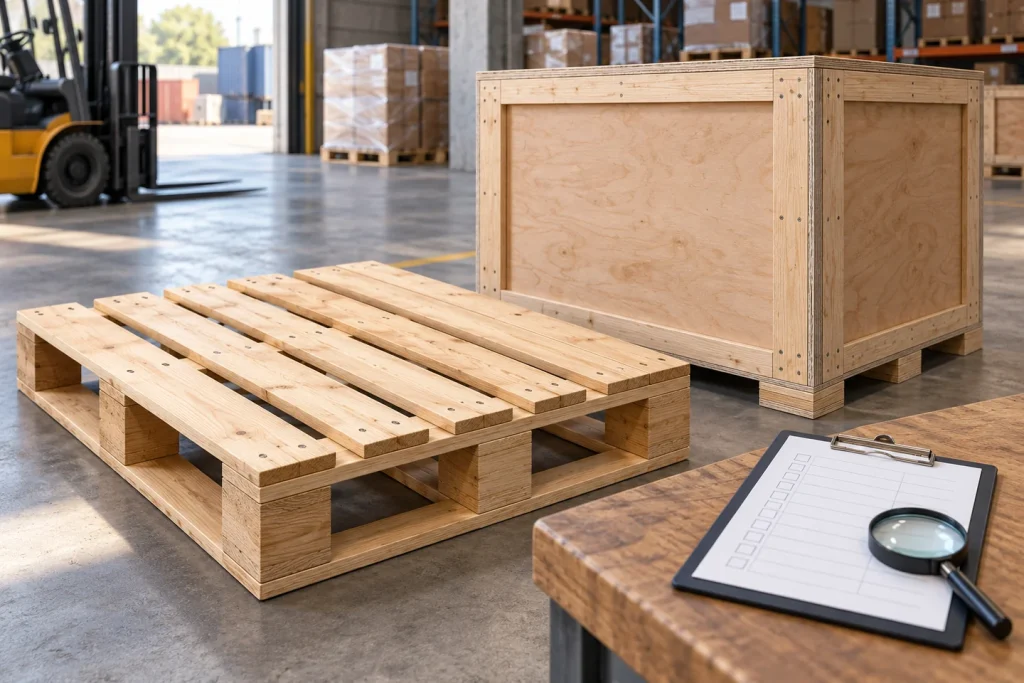
Check pallet and crate materials, authorized providers, marks and unit-linked evidence before shipping from China. Includes repair and consolidation checks.
Start with the wood you will actually ship
A supplier sends a photograph of a tidy plywood crate. The quotation says “export packing,” and someone assures you that it is suitable for overseas shipment. That still leaves an important question unanswered: what are the runners, corner posts and loose support blocks made from? A good-looking crate can contain several different materials, supplied and handled by different businesses. Before accepting it, you need a clear description of the finished packing unit, not just its outer panels.
For wood packaging on a shipment from China, work through four decisions: identify every relevant component, confirm the destination’s current requirements, establish who is authorized to supply and mark compliant material, and connect the evidence to the units actually dispatched. This guide develops that buyer workflow. It does not certify a shipment or prescribe treatment settings. The checklists and examples are practical editorial recommendations, while regulatory statements link to their official sources.
The IPPC’s ISPM 15 publication addresses phytosanitary risks from raw wood packaging, including dunnage. Processed materials such as plywood fall outside its raw-wood scope. Do not extend that distinction to an entire mixed crate without identifying its other components.
Keep the wider purchasing and transport sequence beside this task. Our China import guides cover the surrounding decisions. Here, the useful outcome is a packing dossier that explains what was checked, who resolved the open questions and whether anything changed before departure.
Map the components before discussing exemption
Ask for a simple component schedule. Give each part a name, location, material description and supplier: base pallet, runners, side panels, corner posts, lid, internal braces and loose packing blocks. A sketch can be enough if it matches the final construction. For a closed crate, obtain photographs before the goods disappear behind the panels. Describe unknown parts as unknown; a commercial label such as “wooden box” is not a material specification.
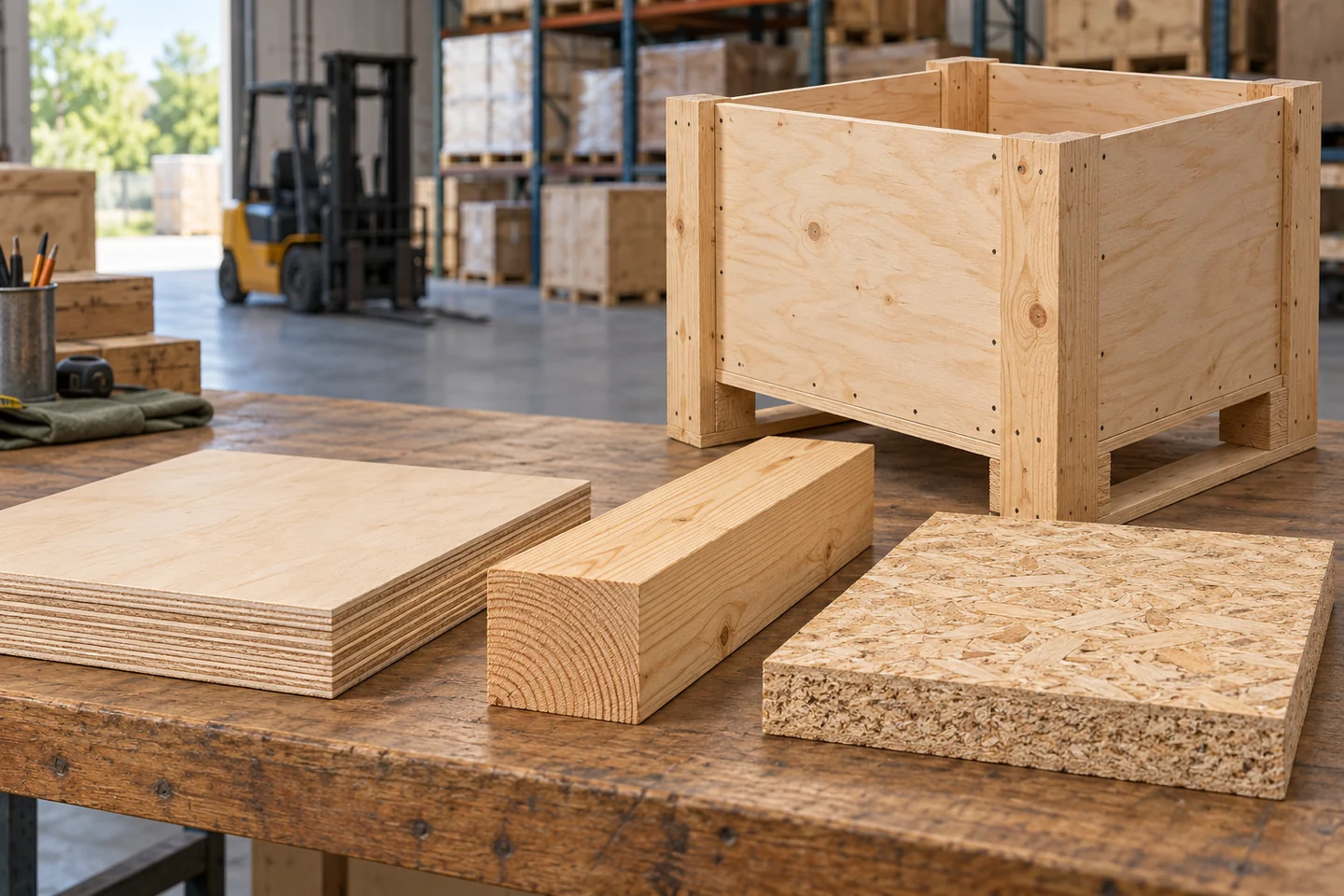
Pictures of edges often help distinguish layered panels from solid boards, but a photograph is supporting evidence, not a laboratory identification. Request the supplier’s material description as well. If a base has been bought separately, ask who made it and whether its specification differs from the crate builder’s usual base. The team assessing the requirement needs the whole assembly, including the pieces that will be added during container loading.
Australia’s Department of Agriculture guidance lists fully processed wood packaging and packaging made entirely from thin wood of 6 mm or less among the ISPM 15 exemptions. It also explains mark elements: the symbol, country code, producer or treatment-provider identifier and treatment code. Australia’s entry rules remain destination-specific.
The word “entirely” matters. A plywood enclosure on solid timber runners deserves a component-level review; the plywood does not settle the runners’ status. Conversely, do not order unnecessary treatment solely because a panel has a wood-like appearance. Send the component schedule to the competent provider and ask which parts require action and why. Preserve that answer with the packing specification rather than relying on a brief telephone reassurance.
Separate the international standard from destination instructions
Write down the intended country of entry, the receiving party and the actual route. Ask the receiving agent which official requirement applies to that packing material and whether additional declarations or evidence are needed. An answer prepared for an earlier shipment to another market should not become the default for this order. The exporter, importer and receiving agent should be working from the same description of the crate.
GOV.UK’s wood packaging guidance advises exporters to check destination requirements and to put packaging requirements into the exporter contract. Use that as a planning principle, while keeping British import and enforcement procedures separate from the rules of your own destination.
For an Iran-bound shipment, obtain the applicable current instruction from the competent destination authority or an agent who can point to it. This article makes no claim that Iran uses the same documents, exceptions or remedies as Australia, the United States or Great Britain. A destination missing from a foreign website’s example list is not evidence of exemption. If the route or receiving country changes, reopen the requirement check before approving the packing.
Keep a dated record of the question and answer: material described, destination, official reference, person responsible for interpretation and any remaining uncertainty. Avoid reducing the file to “ISPM 15 required: yes.” That shorthand hides the conditions and is difficult to review when somebody proposes a different pallet later. A useful record lets the next person see the basis of the decision without reconstructing the entire email chain.
Find the responsible provider, not a printable logo
Begin with the exporter’s packing arrangement. Is the factory buying finished pallets, hiring a specialist crate builder or arranging treatment through a separate provider? Ask for the business responsible for the relevant authorization and the official route for checking it. Match the legal business name, facility and identifier rather than accepting a trading company’s general certificate as proof of another company’s authorization.
The IPPC China country profile provides official national contact and reporting information. It is a starting point for locating competent information; the profile itself is not a list of approved pallet producers. Use the appropriate current national verification channel rather than treating a search-engine result as accreditation.
A buyer’s worksheet can capture the provider name, identifier shown on the packing, verification route, date checked and the person who checked it. If the supplier cannot explain which organization stands behind a mark, keep that question open. Do not copy a sample stamp into a purchase order and ask an ordinary workshop to reproduce it. The desired result is authorized packing with traceable responsibility, not an attractive graphic.
Ask who owns corrections if the received packing differs from the approved drawing. The factory may coordinate the work, but the competent provider should determine the phytosanitary response where required. A purchasing assistant should not have to invent an interpretation under dispatch pressure. Decide in advance who can pause the order, who obtains the answer and who releases the corrected packing for the next stage.
Read a mark in context
Request a clear close-up of the complete mark and a wider photograph showing where it sits on the identified unit. Transcribe the visible identifier into your review sheet and compare it with the provider information. Use the current standard’s annex for the required format. If a character is obscured by wrap, dirt or damage, record the uncertainty and request a better view instead of guessing the character.
Check visibility again after wrapping and assembly. A photograph taken before a side panel was fitted may no longer represent what an inspector will see. Ask the packing team to keep the agreed views available and to flag anything that covers, removes or damages the mark. Where another marking is present, obtain the construction and repair history; the number of visible marks alone is not a reliable explanation of that history.
Do not let a recognizable mark answer unrelated questions. It does not establish load capacity, shock protection, waterproofing, suitability for lifting or conformity of the product inside. Those are separate specifications and checks. Likewise, a buyer’s visual comparison cannot verify treatment performance. It is a screening step that helps you identify discrepancies and direct questions to the responsible authorized organization.
Keep the standard’s treatment codes in their proper role. Seeing HT or another approved code is a reason to check the provider and packing record, not a reason to prescribe a workshop process yourself. This guide intentionally provides no fumigation recipe, exposure duration or chemical handling instruction. Where treatment is involved, use competent providers and follow the applicable safety and regulatory instructions.
Build photographs around the packing unit
A folder of isolated stamp pictures can look reassuring while proving very little about the shipment. Start with a unit identifier that matches the packing list. Take an overall view, a component view where mixed construction matters, and the mark close-up with its location visible. If the order contains different crate designs, identify which design each set belongs to. Do not allow one well-photographed crate to stand silently for a different design.
Keep original files and their relationship to the inspection record. Choose filenames that distinguish the order, unit and view, without placing confidential customer information in publicly shared folders. A contact sheet is useful for quick review, but retain the originals for legibility. If the supplier sends a cropped image, ask for the uncropped context before treating it as evidence of the actual unit.
Record when photographs were taken in relation to packing, repair and warehouse receipt. A photo from a sample order or supplier catalogue should be labelled as an example. After a change, preserve the earlier version and add the new one with a short explanation. This creates a readable history rather than a collection in which somebody has replaced the problematic photo and lost the reason for the decision.
For the broader dispatch record, use the container loading and VGM checklist. That guide owns load arrangement, weight and container evidence. The wood dossier should join that record through unit identifiers, while keeping the assessment of wood requirements explicit. Strong loading photographs do not substitute for a clear material schedule or provider verification.

Handle reused and altered packing as different questions
A used pallet can be undamaged, damaged, repaired or reconstructed. Start by asking what happened to it, rather than assuming that age determines compliance. Obtain the available history, inspect its current condition and identify any replaced components. If the history is unavailable, say so. An old mark on one board does not explain the status of a new board fitted yesterday.
The official Russian text of ISPM 15 distinguishes reuse, repair and remanufacture. The response depends on the actual alteration and authorized controls; “every repair needs exactly the same remedy” is not a sound universal rule. Refer the specific changed unit to the competent provider.
For your own change record, describe the removed and replacement parts, their materials, the reason for the work and the party performing it. Include before-and-after photographs. Do not instruct warehouse staff to add a mark, erase one or decide treatment requirements from this article. Ask the authorized party for the appropriate action and retain its explanation with the final unit record.
This is also a purchasing issue. If a warehouse replaces an approved pallet because it is broken, the replacement can affect dimensions, lifting access and packing evidence at the same time. Update the transport data separately and check whether the receiving team needs a revised packing list. A corrected wood assessment should not leave the freight team using an obsolete size or unit count.

Keep the packing under control between inspection and dispatch
Approval at the factory is only one point in the journey. Identify where the units will wait, who can move them and whether they may be unpacked or transferred to another base. Ask the warehouse to distinguish approved units from units still awaiting a decision. An internal hold label can support that workflow, but it must not resemble or replace an official compliance mark.
USDA APHIS import guidance tells importers to check provider accreditation and inspect for pest signs such as exit holes, feeding traces or frass. Its inspection and response procedures apply to the United States. A suspicious observation elsewhere should be referred to the relevant competent authority or provider.
Photograph an observation and identify the affected unit without trying to diagnose a pest from the picture. Keep the unit out of the normal release flow while the responsible party assesses it. Do not assume that sweeping away residue or painting the timber resolves the underlying question. Record the advice received and the eventual disposition so that the next shift does not dispatch a unit whose hold reason is still open.
The IPPC adopted-standards listing describes ISPM 15 treatment as reducing pest introduction risk, without providing ongoing protection against subsequent contamination. For a buyer, that makes storage and handoff observations relevant even when a mark is present. It does not justify a fixed shelf-life claim for all marked packaging.
Make consolidation a controlled handoff
Several suppliers may deliver cartons and crates to a consolidation warehouse. Ask whether the warehouse will combine them, add timber blocking or replace bases. The final packing can differ from what each supplier approved. Assign a person to reconcile the final unit schedule before the consolidated shipment is released, especially when several purchase orders share one outbound packing list.
Give the warehouse a practical instruction: report proposed wood additions and substitutions before making them; retain the unit identity; obtain the necessary competent review; photograph the final arrangement; and return the revised schedule. This is a recommended operating agreement, not a universal government form. Adapt it to the services the warehouse actually supplies and confirm that the responsible people understand it.
The decision between LCL and FCL for a partial container concerns the wider shipment arrangement. Whichever option you choose, include each party that can alter the packing in the wood control plan. Do not assume that booking a full container eliminates factory substitutions, or that a shared shipment automatically has unacceptable packing. Check the actual handoffs.
When using consolidation and warehousing support, send the material schedule and unresolved questions with the order information. Ask which checks can be coordinated and which require an authorized specialist. That makes the service request concrete and avoids suggesting that routine warehouse receipt alone constitutes phytosanitary approval.

Put an actionable packing specification in the order
Replace the phrase “standard export packing” with a description someone can check. State the construction, destination, unit identification, intended provider verification, evidence required before closure, and the approval route for substitutions. Give each requirement an owner. A specification is useful when the supplier can turn it into a task and you can tell whether the task has been completed.
Keep mechanical protection in a separate part of the same specification. The crate may need a design assessment for the product’s weight and handling method even when the wood evidence is satisfactory. A processed panel is not automatically strong enough for the load. Confirm the relevant design requirement with a competent packing specialist rather than treating a phytosanitary exemption as a performance guarantee.
| Review item | Ask for | Keep open when |
|---|---|---|
| Material | Schedule of panels, runners, braces and loose timber | The description covers only the outside |
| Destination | Current official requirement and responsible interpretation | The answer relates to another market |
| Provider | Applicable authorization verification and identifier | The marked provider cannot be connected to the record |
| Unit evidence | Overall, component and mark photographs | The photographs cannot be matched to dispatch units |
| Changes | Replacement history and competent decision | A new board or pallet appeared after review |
Discuss costs through the actual work proposed: different materials, specialist assessment, packing changes, additional handling or storage while a question is resolved. Ask for a written quotation and its assumptions. This guide provides no standard surcharge, treatment price or guaranteed turnaround. The useful comparison is between complete, clearly described options for your product and route.
Three situations that test the workflow
A plywood crate with solid runners
In this hypothetical order, the factory calls the crate “non-wood packing” because the sides are plywood. The buyer obtains an assembly photograph and sees solid runners beneath it. The next step is a component-specific assessment, not an argument over the marketing label. The buyer asks the competent provider to review the runners and records the final material schedule. Transport dimensions are checked against that same finished crate.
A clear mark on a pallet that was later repaired
A second hypothetical buyer has a readable mark photograph, but the warehouse receipt image shows a lighter replacement board. The earlier evidence is retained and the change is documented. The pallet waits for the responsible provider’s decision on the specific repair. Nobody assumes that the old photo covers the alteration, and nobody orders an improvised stamp. Release follows the recorded decision and the final condition check.
A consolidation warehouse adds support blocks
In the third example, several approved cartons arrive without loose timber, then the warehouse proposes blocks for the outbound arrangement. The buyer asks for the material and provider information before those blocks become part of the shipment. Any necessary assessment is coordinated alongside the loading plan. The final photographs show the added components, and the outbound schedule explains what changed. These examples illustrate decisions, not actual customer cases.
Close the file before releasing the shipment
Hold a short release review with the people who control packing and dispatch. Look at the final component schedule, destination basis, provider verification, actual unit photographs, change history and unresolved observations. Ask whether the approved construction is the construction now waiting to leave. Record a named release decision; silence in a group chat is a poor substitute for someone taking responsibility for an open item.
If something remains unresolved, state the question precisely and identify the next evidence needed. “Packing rejected” is less useful than “replacement runner material and provider verification outstanding.” Give the supplier a clear route to correction while preserving the earlier record. When the answer arrives, review the affected parts and any dependent information; do not automatically repeat unrelated checks or erase the reason for the hold.
Keep risk and insurance questions separate. Our cargo insurance guide for imports from China explains the broader insurance review. A policy should not be treated as a substitute for packing compliance, and this article makes no promise about cover for a particular packing problem. Ask the insurer or broker about the actual policy and disclosed circumstances.
For a sourcing or warehouse discussion, prepare the product description, destination, packing sketch, photographs and unanswered questions. That is enough to start a focused conversation about who needs to review what. The objective is a legible decision trail from the proposed packing to the unit handed over for transport, with specialist judgments clearly attributed to the people qualified to make them.
Questions buyers ask before dispatch
Does a plywood crate automatically avoid ISPM 15 checks?
No. Identify the whole construction, including runners, posts, braces and loose supports. Processed plywood and solid timber are different material questions. Have the competent party assess mixed construction against the applicable requirements instead of relying on the crate’s commercial name.
Can we verify compliance from a stamp photograph?
A photograph helps screen the visible mark, but it does not establish treatment performance or provider authorization. Match the mark to the responsible provider and the actual dispatch unit, then obtain the relevant competent verification. Keep unreadable details open rather than guessing.
Is a separate certificate always required for every destination?
Do not assume one document rule applies everywhere. Confirm the current destination requirement for the specific material and shipment, with an official reference. Requirements for the product itself and for wood packaging can also differ; keep the two questions separate.
What should we do if a marked pallet has a replaced board?
Document the alteration, replacement material and available history, then refer the specific unit to the authorized provider or competent authority. Preserve before-and-after evidence and obtain the appropriate decision. Do not add, erase or copy official marks as a buyer’s workaround.
Does the mark prove that a crate is strong enough?
No. Load capacity, lifting access, shock protection and moisture protection need their own packing specification and assessment. A satisfactory wood compliance review cannot replace a mechanical design check for the product, weight and handling method.
Who checks timber added during consolidation?
Agree responsibility with the warehouse before dispatch. Require proposed additions or substitutions to be reported, assessed through the relevant competent route and included in final unit evidence. Routine warehouse receipt alone should not be treated as approval of newly added timber.
What should be in our final packing dossier?
Keep the component schedule, destination reference, provider verification, unit-linked photographs, available change history, resolved observations and named release decision. This is a recommended buyer dossier, not a substitute for any official document required by the destination.
Official references and review date
Sources reviewed on 3 October 2026: ISPM 15 publication, adopted IPPC standards, official Russian standard text, Australian guidance, APHIS import guidance, GOV.UK guidance and China’s IPPC profile. The IPPC’s 2023 implementation guide is a further official resource on treatment, marking, repair and inspection. Check current destination instructions again when preparing a shipment.



[…] Related guide: checking wood packaging and ISPM 15 before shipping from China […]