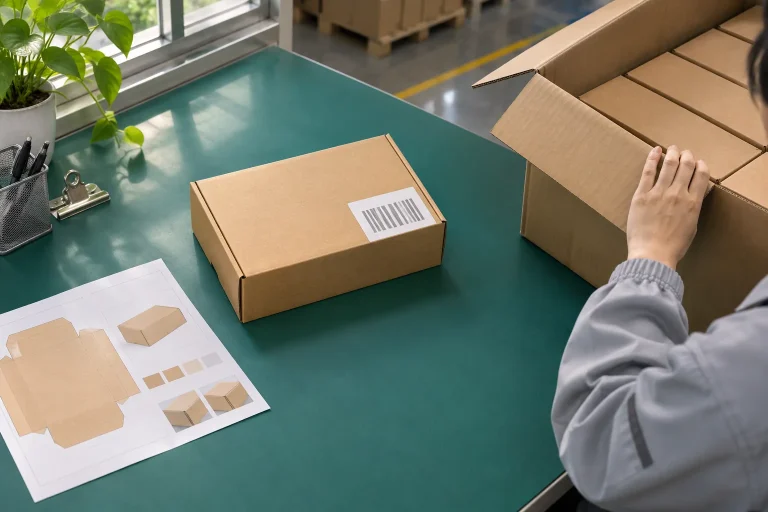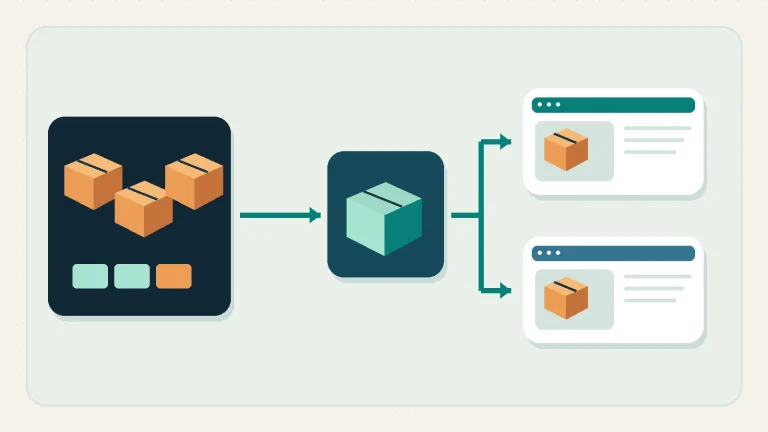
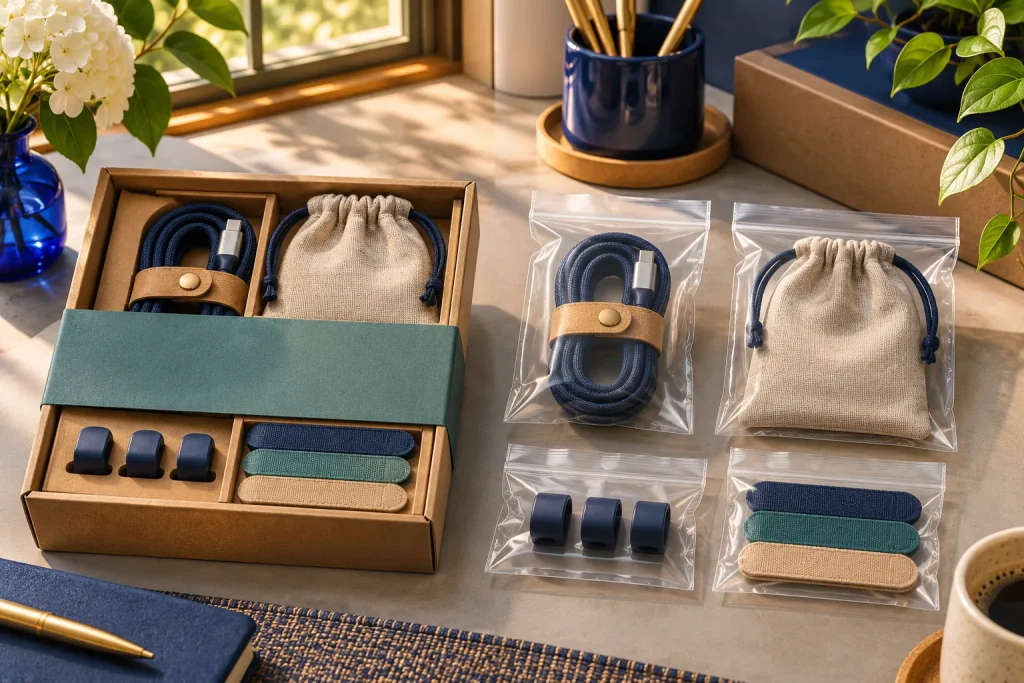
Compare a finished set from a Chinese factory with a fixed Shopify bundle. Test the pick list, parcel and return before ordering stock.
Decide where the set gets its final form
You have three desk accessories on the supplier’s quote, and you want to sell them together on Shopify. Before you order the first batch, decide what should arrive at your warehouse. Buy a factory-packed set if the customer should receive one sealed product and your team can commit to its exact contents. Buy the pieces separately and use a fixed bundle in Shopify Bundles if the same pieces also need to sell on their own and your fulfillment team can reliably pick the full combination. Ask the warehouse to run one ordinary order and one exception before making the purchase commitment. That exercise often tells you more than another round of discounts on the boxes.
Consider an educational example throughout this guide. A stationery retailer wants to launch a small desk cable kit made up of one soft pouch, two reusable ties and one cable clip. In the factory-packed model, the pouch, ties and clip arrive together in a sealed retail carton. In the component model, the retailer orders pouch, tie and clip stock and groups them in an offer on its own Shopify Online Store. The customer sees a kit on the product page in both cases. What changes is the purchase unit, what the picker receives on the order and which piece the business can replenish or replace later.
The software option here is the first-party Shopify Bundles app, with a fixed recipe and the standard Online Store as the sales channel. Start with Shopify’s description of its own bundle app to distinguish fixed bundles and multipacks from other tools. An ordinary physical product can also consist of several items in a package. Giving a ready-made set a single Shopify product record does not, by itself, require using a bundle app. For the broader purchase process, see the China sourcing and import guides.
Ask two suppliers to price the same customer promise
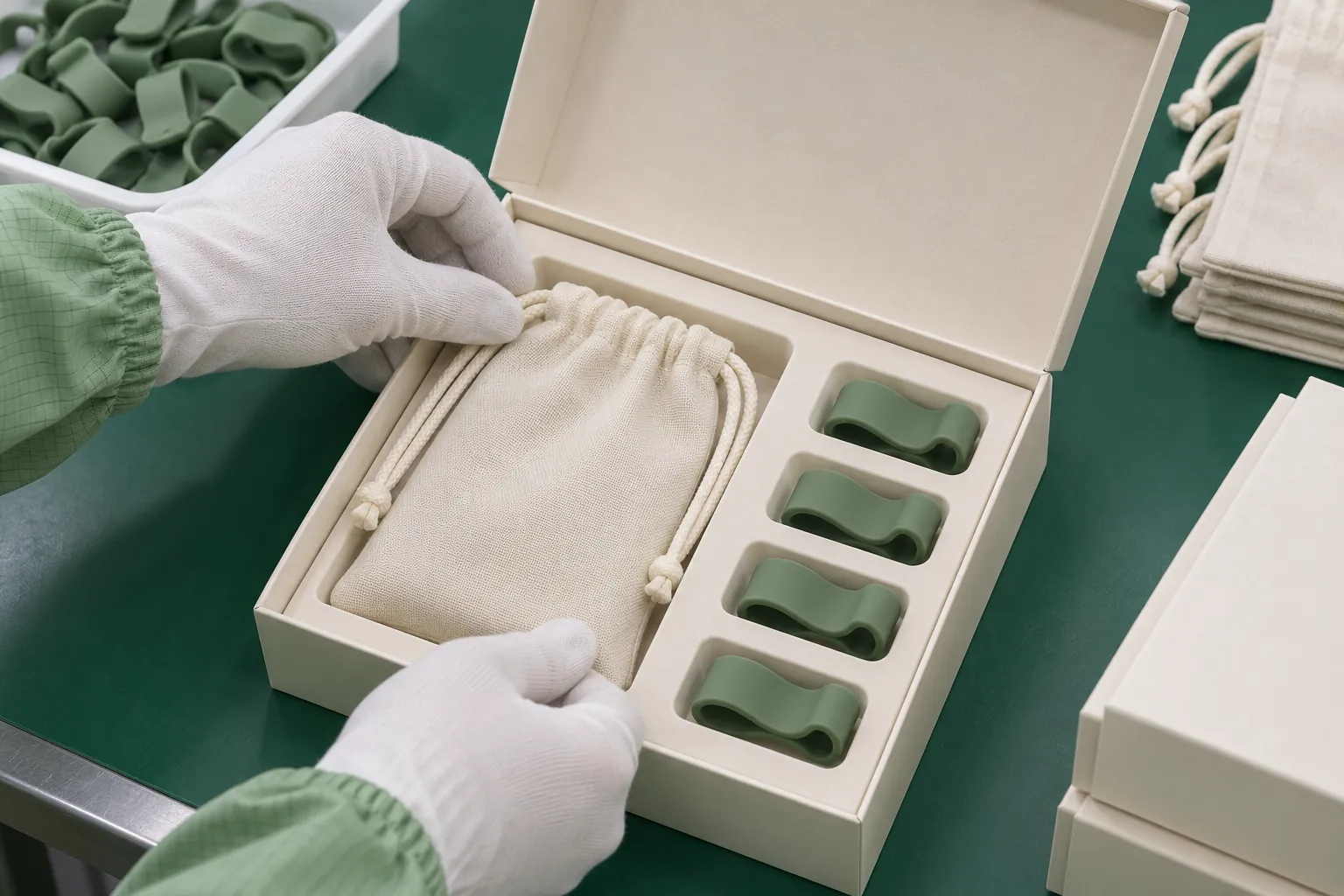
Hand each supplier a specification for the item the customer will receive. For the cable kit, say how the pouch closes, which ties it contains, whether their colors may vary and where the clip sits in the package. Identify components by your own stable references in addition to any supplier model numbers. Attach an annotated photo for things that are easy to describe badly, such as a tie’s usable length after it is wrapped around a cord. The factory quote for a finished product should state what it buys, assembles, inserts and packs before delivery at the agreed stage. Ask whether any accessory comes from another supplier and who signs for its correct inclusion.
For a comparable component quote, request the same pieces in their own supply packs. Specify their condition on arrival. A pouch supplied flat in stacks may be appropriate for local assembly. If it will also sell as a standalone item, it may need a sleeve, its own identification or some protection for the zipper. Quote those choices explicitly. Otherwise, a low component price can look attractive because the supplier has left packaging and sorting for somebody else to pay for. For a structured supplier shortlist and comparable offers, see China Moshaver’s product sourcing service.
Set targets on the same basis. Suppose the retailer wants enough product for 240 kits and also plans to sell spare ties. Request a price for 240 sealed kits and a separate price for the extra ties. In the other quote, request 240 pouches, 480 ties for initial kit demand, the planned spare ties and 240 clips. Record each supplier’s respective minimum and pack multiple before treating the requested numbers as purchasable. If the clip supplier will ship only cartons of 100, three cartons leave 60 clips after the initial kit run. Put that residual stock on the decision sheet. The guide to negotiating factory minimum orders explains how to ask which constraint drives a quoted minimum.
Have the factory fill one actual retail pack and send it closed. Open and count it using the customer instructions as the reference. Ask another person to make a sellable kit from the locally assembled version using only the bin references and quantities on a packing sheet. Photograph the two presentations and keep an agreed reference with the purchase file. If there is a difference you would need to explain to the customer, rewrite the offer or the packaging specification while both are still easy to change. The guide to specifying and approving samples can help you make that sign-off reproducible.
Work out what an order should tell the picker
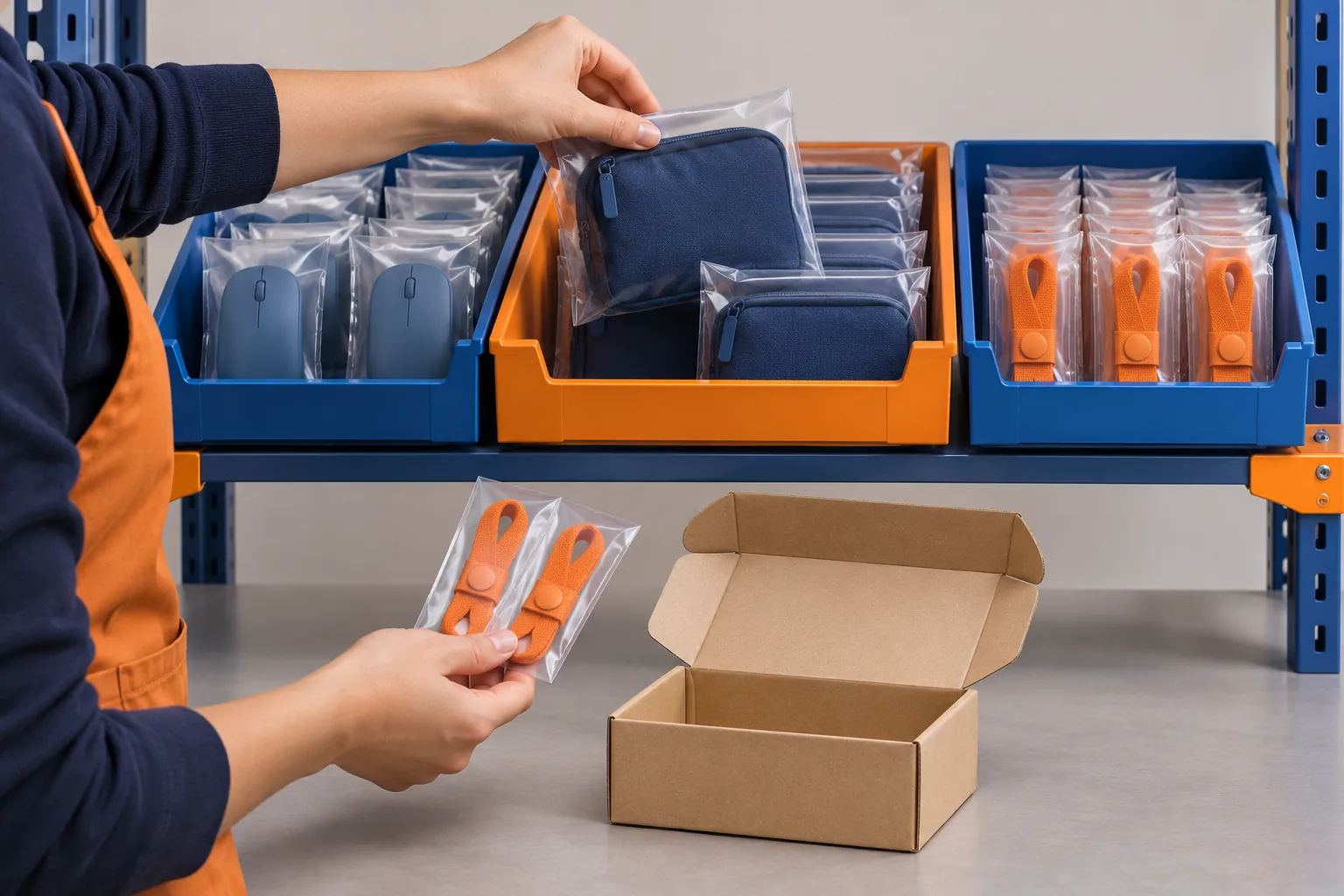
Under the sealed model, create and track the finished retail set as an ordinary physical product variant with a distinct SKU. Its label tells the warehouse that one unit is ready for an order. The internal parts still need a bill of materials for factory control, but your normal pick instruction is simply to take one sealed kit. Shopify explains how to use SKUs for products and variants. Keep the supplier’s carton number and your finished-item SKU in separate columns. A transport carton with twenty retail packs is useful receiving information. It is still twenty sellable units rather than a single item to add to the listing.
The fixed-app option starts with separate product variants in the store. Specify the exact variants and quantities before creating the grouping. A blue pouch in a kit should refer to the same approved variant the warehouse uses, even if the product page uses a friendlier color name. In Shopify’s first-party Bundles documentation, the order processing limitations identify component SKUs as the individual pick references. The bundle considerations guide also describes grouped display in places such as checkout and itemized views where split fulfillment or returns are handled. Ask your fulfillment partner for a representative pick ticket and compare what its integration actually receives with what Shopify shows.
Write the order-control check in observable terms. For one kit, can the picker see one pouch, two ties and one clip? If there are two kits and a separate clip on the same order, does the receiver of the instruction know that the total is three clips and that one was bought separately? A component count alone is enough to pack this example, but the grouping matters if the buyer returns one kit and keeps the extra clip. Retain the exported order number and a record that shows the grouping, line quantities and actual output. Repeat the exercise with a new hire or second shift. If only the person who created the listing can interpret the result, the operation is fragile.
Some teams build the kit after the order but still represent it as a single physical SKU. That arrangement can work if stock has already been assembled and assigned to that SKU, or if the warehouse has a separate, tested manufacturing or kitting process for allocating components. Decide which situation you are buying for. A sealed kit that is already counted is operationally different from unloading loose pieces and expecting a fulfillment system to consume them correctly. If one stream is converted into the other, record the quantity consumed and quantity of the resulting packs before making them available. Follow the carton traceability guide for preserving identifiers where shipment cartons are repacked.
Make variant choice visible in that same test. Suppose the retailer advertises a navy or gray pouch but the two ties and clip are identical in both offers. For prepacked stock, ask the supplier to send a known quantity of each finished variation in distinguishable retail packs. When the customer selects gray, the warehouse must be able to pick that finished unit without opening another box to check. For the fixed-app option, use the allowed variant combinations in the app and review the selection on the storefront. One color selection might change only the pouch line, while the tie and clip quantities should stay the same. Ask the picker to fulfill one order for each color with the web-page names hidden. Then compare the delivered items with the original selections. This exposes a variant mix-up that a one-color test would miss, even when the amount charged and the total number of components are both correct. If you intend to allow choices in more than one component, verify what the chosen app actually supports before ordering more variants.
What complete sets can you actually put in a parcel?
The useful calculation is tied to the recipe. With 120 available pouches, 310 ties and 90 clips, a recipe requiring one pouch, two ties and one clip can support 90 complete sets from those quantities. The ties support 155 sets, so adding ties has no effect on that constraint. Shopify’s bundle availability documentation describes dividing component availability by the required quantity and taking the lowest whole result. It also documents settings which can exclude a component from the availability calculation, including untracked inventory and continued selling when out of stock. Use consistently tracked test variants so you can tell why the displayed quantity changed.
A calculation based on a total does not ensure the parts share a dispatch point. Imagine the 90 clips are in a backup location while all approved pouches and ties sit at the main site. That was enough on the spreadsheet. Neither site can pack one kit as a single parcel. For this example, an acceptable process either moves clips before opening sales for the set or demonstrably supports a customer experience that matches the offer. Shopify explains the checkout conditions under which orders can split. Its own Bundle app documentation describes inventory tracking for bundles as overall rather than location-based. Try a staged order using the locations and partner integration you plan to run. Use the existing Shopify and TikTok Shop inventory guide for the separate question of whether replenishment in transit is ready for sale.
Think about how you would count the finished alternative after receiving it. If 90 sealed boxes have arrived in acceptable condition, they are 90 finished units that are ready for customer orders. Suppose seven boxes show signs of damage to the presentation packaging. Pull them aside until the agreed disposition is known. The spare ties you purchased for standalone sale cannot make those seven boxes whole. By comparison, if seven separately stocked pouches were flawed but you had additional approved pouches, you could still make the full kits. Weigh the value of substitutable approved stock against the labor of confirming each complete order.
Price the point where assembly and freight change hands
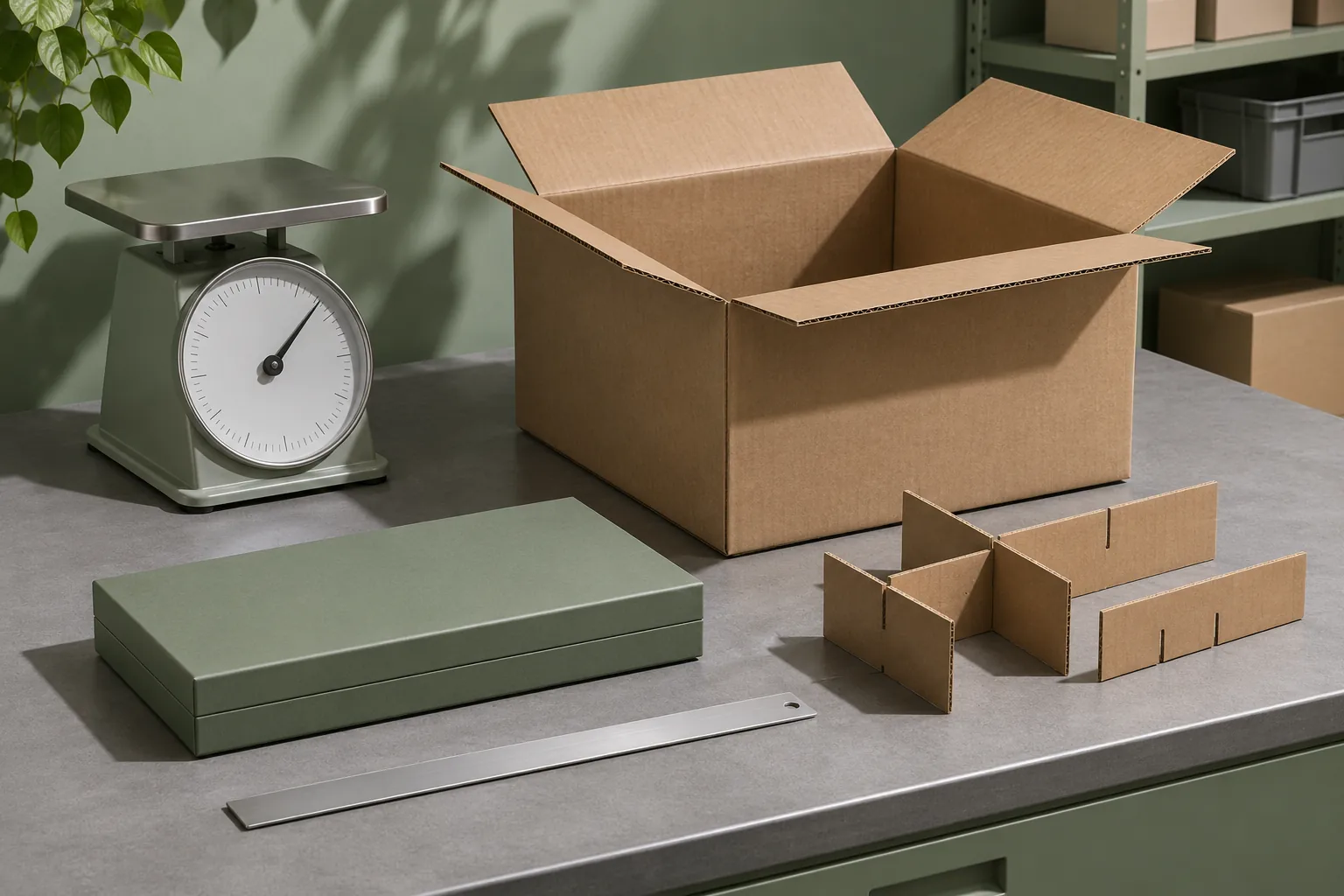
Put the two packing samples on a scale. Record the dimensions and gross weight of the retail kit, the transport case from China and the final parcel to the customer as separate quantities. With a custom retail insert, the presentation carton might become wider even when the components do not change. With a locally picked kit, you might use a stronger outer parcel because the items cannot be immobilized in the same way. Ask each provider which dimension and weight inputs it will actually use. Shopify’s ordinary physical product settings describe the product weight and assigned packaging fields. In the checkout context, the first-party Bundles app guide describes weight calculation using the individual items, and Shopify’s bundle considerations say component shipping profiles supply the rates. Compare one actual packed test parcel from each workflow with the rate shown on checkout for a destination where your store already sells.
Use two simple figures for a commercial discussion. First, estimate the up-front commitment that can’t be redeployed easily, such as a set-specific insert, printed carton and sealed finished stock. Second, estimate ongoing work that rises with each shipment, such as picking three bins, checking the recipe and adding protective packaging. In a fictional 240-kit order, a finished quote includes assembly and retail packaging for 1.80 per kit in assumed accounting units. In the component model the retailer budgets 0.55 for local packing material and 1.05 for the extra picking and packing time, totaling 1.60. The 0.20 difference is 48 over 240 complete orders under those assumptions. A second parcel, an omitted item or unusable excess clips can move the answer. Those figures illustrate how to compare two assumptions rather than represent prices.
Check those inputs again after a pilot. Ask whether the picking quote charges per unit, per extra line or per package. Two identical ties might be one line with quantity two, yet the physical count still requires two pieces. An order for several kits might no longer fit the carton dimensions used in the sample. A branded factory box might still need a transit outer carton to maintain its appearance. Include the test with an adjacent product in the basket. A beautifully presented standalone kit can still become a shipping problem when it rides with a heavier item.
If separate suppliers ship to a facility in China before export, write down whether the job there is to combine transport cartons, count supplied units, repack retail items or assemble a final product. The distinctions affect the work order and the receiving evidence. Discuss any actual China-side sorting or packing scope through the consolidation and warehousing service. For the wider process around choosing suppliers and arranging a purchase, use the China Moshaver overview of buying from China. Test the destination warehouse workflow and checkout separately with the people who own them.

Decide what happens when one piece changes
During the second run of the fictional kit, the pouch supplier offers a replacement with a longer zipper and a slightly different size. A goods receipt notice alone cannot authorize that change. Compare the replacement against the product promise and the package that has already been approved. If using the finished model, test whether it fits in the insert and whether any new item identifier and listing update are needed. Keep old and proposed versions physically distinct until the decision and quantities are documented. None of this requires accepting that two pouches are interchangeable just because a supplier sold them under a similar name.
With the app, decide whether the approved change requires a different component variant or SKU. Shopify’s bundle compatibility guidance says that when a component’s SKU changes you need to recreate the bundle. Set aside time to verify the new configuration from the customer-facing page through checkout, the warehouse pick instructions and service handling. Keep a reference to the old order lines after the new offer is configured. A customer with an order made before the change should still be able to find out what exact combination was purchased. Write the approval and test requirements into the change request before the replacement stock comes in.
Run a return exercise too. Say the customer receives the correct kit but finds one damaged clip. In the finished model, decide up front whether the seller can offer a replacement piece under its policy and applicable rules, where replacement pieces are recorded and what happens to incomplete returned kits. In the app model, check how the order and return screens refer to the damaged component. Shopify describes bundle return eligibility in terms of the components and explains that included items can appear separately in return workflows. Have customer service and the warehouse verify that a clip can be recognized without accidentally returning a separate clip from the same purchase. Decide who authorizes a replacement, how to record it and what must be physically inspected before any returned stock is put back.
Use the pilot to release one of the two purchase orders
Write a short acceptance sheet before placing the order. Include the product description, complete recipe, release samples, identity of the unit you expect to receive, the ordinary order and the order with an extra component. Add a case involving one missing part or a replacement pouch. Record the intended checkout parcel configuration, actual parcel weight and dimensions, and the person responsible for updating any product representation. The record should name the proof for each line, such as one closed sample on the worktable, a representative order record or a return record with the correct part. Save the rejected outcome as well. It tells the next person why a cheaper configuration was ruled out.
For the desk cable kit, a retailer with a stable gift-ready format and a team that picks sealed retail units could reasonably choose a factory-packed batch. A retailer that already sells the same pouches and ties separately could choose the component option if its tests confirm that the right location can pick all the pieces, shipping presentation matches the promise and customer service can resolve item-level exceptions. If the pilot leaves one of those uncertain, order samples or a limited trial that resolves the uncertainty before committing to bulk stock. Take the completed sheet and the two comparable supplier quotes to the purchasing discussion.
Questions before committing to a kit
Can a ready-made kit be a normal Shopify product?
Yes. If the sealed kit is stocked and shipped as one retail unit, it can be represented as an ordinary physical product variant with its own SKU. Retain the factory’s list of approved pieces for sourcing and inspection.
Does the Shopify Bundles app put the pieces in one parcel?
The app creates the sales grouping. The actual parcel depends on the components, fulfillment locations and order handling. Verify the result with a representative order using the location and integration that will fulfill it.
Can the same pouch be sold on its own and inside the kit?
With a fixed app bundle, use the intended pouch variant as a component and test the inventory settings. With a sealed kit SKU, keep separately sellable pouches distinguishable from pieces already packed into kits.
What if the supplier replaces a component after approval?
Review the exact proposed part against the product promise and packing sample. If its Shopify SKU changes, follow Shopify’s documented bundle handling and confirm the new offer all the way to the pick ticket.
Does this comparison apply to TikTok Shop orders?
It uses the first-party Shopify Bundles app and the Shopify Online Store. Confirm a separate marketplace’s bundle rules and your integration before using the same offer there.