

A model-specific guide to classification, UN 38.3 evidence, packing, documents and real air or sea carrier acceptance.
Direct answer: Shipping a battery product from China starts with exact classification, not with asking for a generic freight rate. Confirm the chemistry, whether the item is a cell or battery, its watt-hour rating or lithium content, whether it travels alone, packed with equipment or contained in equipment, its condition, quantity and route. Match the exact model to valid UN 38.3 evidence, build the applicable package and document set, and obtain written acceptance from the actual carrier before cargo handover.
Why battery freight must be designed before the purchase order
Batteries are energy sources that can create heat, fire and short-circuit risks when damaged, incorrectly packed, poorly manufactured or exposed to unsuitable transport conditions. That does not mean every battery shipment is impossible or equally restricted. It means the commercial team cannot treat transport as a last-minute booking task. A supplier may quote an attractive EXW price while lacking model-level test evidence, suitable packaging, a dangerous-goods declaration process or access to an accepting carrier. When that gap appears after production, the importer may face repacking, storage, route changes, split shipments or a cancelled booking.
The safer sequence is to qualify the product and transport path together. Put battery data and evidence deliverables into the request for quotation, sample approval and purchase order. Ask who manufactures the cell, who assembles the battery, which exact model was tested, which packing configuration will be used and which party will prepare the transport documents. Connect this work with the China Moshaver guides hub and the import documents guide, because the battery file must reconcile with the wider commercial and shipping file.
Step 1: identify chemistry, rating, configuration and condition
Begin with a product-level inventory rather than a catalogue description. Record the commercial model, cell model, chemistry, nominal voltage, capacity in ampere-hours, watt-hour rating, battery count per device, spare count per package, gross mass, manufacturing site and intended mode. For lithium metal, record lithium content where relevant. For rechargeable lithium-ion and sodium-ion products, do not infer the rating from marketing copy; obtain a stable specification and check the arithmetic when voltage and capacity are supplied separately. A mixed carton can contain more than one classification decision.
Then decide the physical configuration. Standalone cells or batteries are different from batteries packed in the same package with equipment, and both differ from batteries installed in equipment. A power bank is treated as a battery rather than as equipment containing a battery. The current IATA guidance maps lithium metal to UN 3090 or UN 3091, lithium ion to UN 3480 or UN 3481, and sodium ion to UN 3551 or UN 3552, depending on configuration. Do not copy a UN number from a previous shipment merely because the outer product looks similar.
Condition is a separate gate. New, normal production stock is not the same as prototypes, low-production runs, used units, returns, waste, damaged items or recalled products. Ask the supplier to quarantine swelling, leakage, crushed housings, exposed terminals, thermal events and units associated with a safety recall. The air guidance forbids batteries identified as damaged or defective where they could produce heat, fire or short circuit, including relevant batteries installed in equipment. Such cargo needs specialist evaluation and must not be quietly mixed into normal export stock.

Step 2: make the UN 38.3 evidence model-specific
The UN Manual of Tests and Criteria provides the test framework used to show that a cell or battery design type can withstand defined transport-related conditions. The practical importer question is not simply, “Do you have UN 38.3?” It is, “Does the evidence identify the exact cell or battery design type in the product we are buying?” Compare manufacturer identity, model number, physical description, mass, watt-hour rating or lithium content, test laboratory, report reference, test date and revision. If the product uses an alternative cell or battery pack after the sample was approved, reopen the review.
A test summary must be made available through the supply chain for applicable designs. It does not necessarily need to be a paper document physically attached to every parcel, but someone responsible for the shipment must be able to obtain and present it. The summary should be traceable to the underlying report and the current model. A safety data sheet can support hazard communication, yet a generic sheet is not a substitute for design-type test traceability. Likewise, a photograph of a certificate page without a verifiable model match is weak evidence.
For private-label products, map four identities: the cell maker, battery pack maker, finished-goods factory and brand/importer model. Record substitutions through change control. If an assembler combines tested cells into a new battery design, do not assume the cell report automatically covers the assembled battery. Where a special provision or exception is claimed, ask the competent dangerous-goods specialist to document the rule, facts and approval path. The objective is a reviewable evidence chain, not a folder full of unrelated PDFs.

Step 3: determine the current air-transport pathway
For air cargo, use the current ICAO Technical Instructions and the carrier’s adopted operating requirements. The 2025–2026 ICAO edition remains the operative biennial edition through 31 December 2026, while addenda, corrigenda, state variations and operator variations can change what a routing accepts. IATA’s 2026 guidance is based on that framework and the 67th edition of the Dangerous Goods Regulations. A quotation from an intermediary does not override the accepting airline’s decision.
State of charge is a major planning point for rechargeable cells and batteries. Current air rules impose a 30% state-of-charge limit on specified lithium-ion configurations, and 2026 guidance extends or changes controls for certain batteries packed with equipment. Batteries contained in equipment may be subject to recommendations or additional conditions depending on the case. Do not turn this into a universal slogan. Determine the applicable packing instruction, configuration, capacity and any approval option, then record how state of charge will be measured and controlled at production.
Air acceptance also depends on quantity, package limits, aircraft type, documentation, marks, labels, training and the operator’s own restrictions. Some configurations may be limited to cargo aircraft; some carriers decline certain battery commodities entirely or only accept them from approved dangerous-goods agents. Confirm the origin airport, transfer points and destination, because a change of gateway can introduce another state or operator variation. Obtain acceptance before moving cargo to the airport warehouse.
Step 4: determine the current sea-transport pathway
Sea freight is not a regulatory shortcut. Ocean shipments use the IMDG Code together with national, port, terminal, vessel and shipping-line requirements. The IMO states that the 2024 IMDG Code edition incorporating Amendment 42-24 becomes mandatory on 1 January 2026. Classification, packaging, marks, documentation, stowage and segregation still require competent handling. A forwarder’s willingness to collect cargo does not prove the ocean carrier has accepted the declaration and package.
Ask for written confirmation of the booking commodity description, UN entry, class, packing group if applicable, package type, number of packages, gross and net quantities, container plan and dangerous-goods declaration responsibility. Clarify whether the shipment is less-than-container load or full-container load, because consolidation adds warehouse and compatibility decisions. For a full container, integrate the battery plan with the container loading and VGM checklist. The shipper still needs accurate weights, package securing and a controlled handover record.
Sea transit may be longer and expose cargo to heat, humidity, vibration and multiple handling events. Packaging should therefore be designed for the real route, not only for a laboratory drop test or a short truck movement. Ask how cartons will be palletized, protected from moisture, kept away from crushing loads and inspected before container closure. Check whether the line, port or destination applies extra documentary lead time or pre-approval. Air and sea quotes should be compared only after both include the correct compliance scope.
Packaging: prevent short circuit, movement and accidental activation
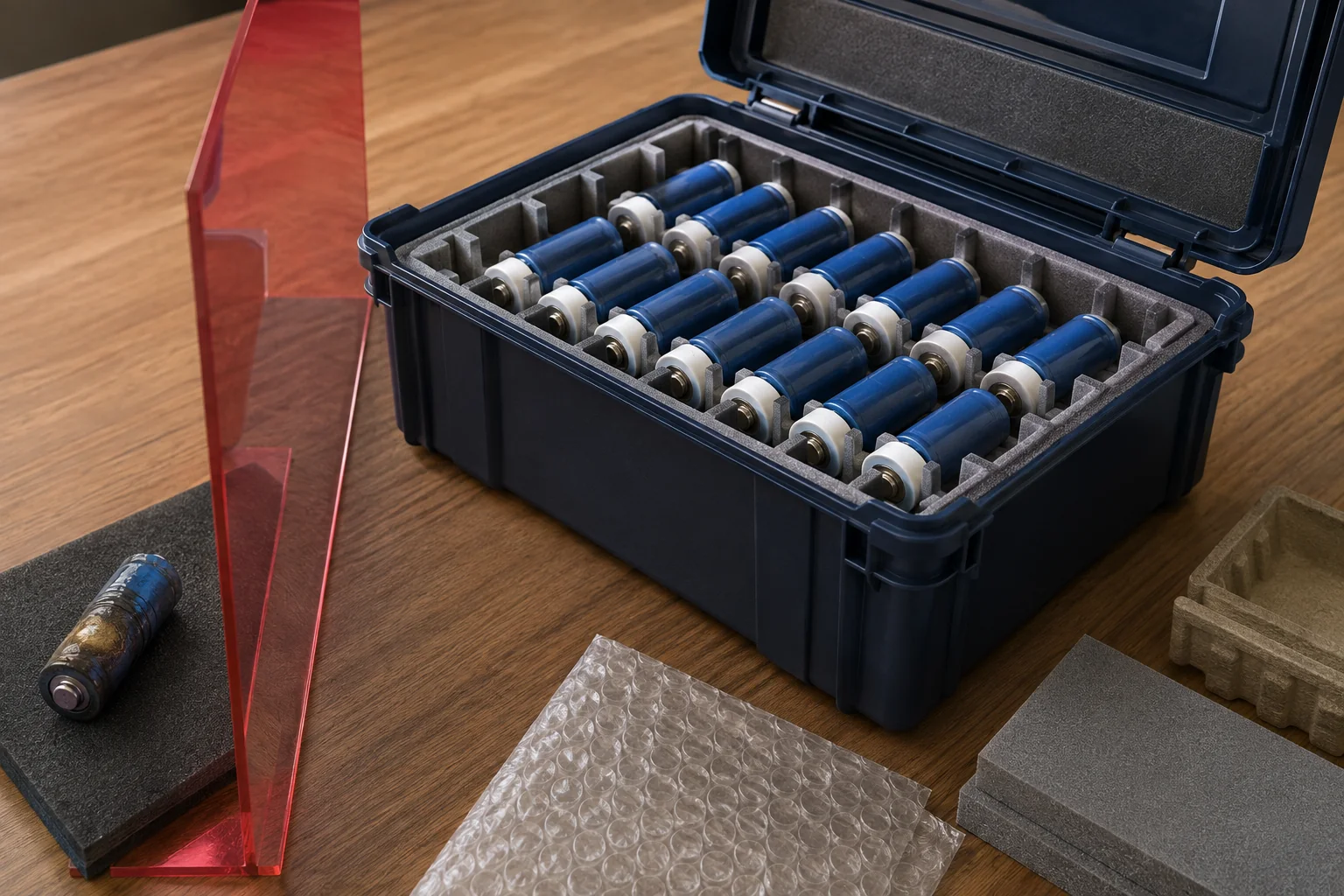
Short-circuit prevention starts at the cell or battery terminal. Depending on the product and rule, this can involve non-conductive caps, recessed terminals, individual inner packaging, insulating tape, molded dividers or another verified method. Do not allow loose cells to contact one another, conductive tools or metal parts. Inner packaging should prevent movement and preserve terminal protection through vibration and handling. Outer packaging must be strong, compatible with the contents and closed using the tested or specified method.
Equipment must be secured against movement and accidental operation. Switches should not activate under normal package pressure, and exposed accessories should not bridge terminals. Heavy batteries need cushioning and load distribution that protect both the battery and adjacent products. If a package design is performance-tested, changing closure tape, absorbent material, carton grade, inner layout or maximum gross mass may invalidate the intended configuration. Treat packaging specifications as controlled production documents.
At pre-shipment inspection, sample opened cartons across production lots. Verify model, quantity, orientation, terminal protection, dividers, cushioning, package condition and closure. Photograph the steps without showing private credentials or pretending the photos are regulatory approval. Record who performed the check, when, against which packing instruction or approved work instruction, and how any nonconformity was closed. The inspection and quality-control service can be scoped around these observable controls, while classification and declaration remain with qualified dangerous-goods parties.
Build one reconciled battery document pack
A useful document pack connects commercial identity, technical identity and transport identity. It may include the purchase order, commercial invoice, packing list, product specification, photographs, cell and battery model map, UN 38.3 test summary, underlying test-report access route, safety data information, package specification, state-of-charge record, declaration drafts and carrier correspondence. Not every document applies to every shipment, but every material statement should agree across the set.
Reconcile names and quantities before submission. The invoice might say “portable charger,” the technical sheet “rechargeable power module,” and the booking “electronic accessory.” That inconsistency can hide the fact that the product is a power bank classified as a battery. Align the finished-goods model, battery model, watt-hours, count per package, package count and gross mass. If several SKUs share one battery, show the relationship explicitly. If a supplier uses multiple cell sources, disclose and control the variants.
Control versions in a simple register with document owner, date, revision and approved use. Store the carrier’s written acceptance with the final booking, not only in a chat application. Keep rejected drafts so the team understands what changed. The file should allow an independent reviewer to answer: what is being shipped, how is it classified, which design was tested, how is it packed, who prepared the declaration, which route and operator accepted it, and what changed after acceptance?
Supplier questions that expose weak evidence early
Ask direct, model-based questions before paying a production deposit. Who manufactured the cell and battery pack? What are the cell and pack model numbers? Does the test summary name those models? Can the supplier provide the full report through a controlled channel if requested? Is the product a battery, equipment packed with a battery, or equipment containing a battery? What is the watt-hour rating and how is it calculated? Has the design, cell source, protection board or enclosure changed since testing?
Continue with logistics questions. Which Chinese dangerous-goods agent and carrier have accepted the same configuration recently? Was that acceptance for the same origin, destination, quantity and mode? What packaging instruction and package design were used? How will state of charge be controlled? Who applies the required marks and labels, who signs the declaration, and who is trained for that role? What is the contingency if the booked operator declines the cargo?
Answers should produce evidence, not reassurance. “We ship every week” is not a model match. “Our forwarder handles it” does not assign legal or operational responsibility. “Battery certificate included” is incomplete without scope and revision. Add the agreed deliverables and change-notification duty to the purchase order. If supplier qualification is still open, use the supplier and factory verification service to confirm business and production facts, while keeping dangerous-goods technical approval with competent specialists.
Compare freight quotations on the same compliance basis
A low rate may exclude the work that makes the shipment acceptable. Request a line-by-line quote showing pickup, dangerous-goods handling, document review, repacking, special warehouse fees, security screening, airline or line surcharge, terminal fees, export declaration, origin storage, destination handling and any inspection charge. State whether quoted transit time begins at factory pickup, warehouse acceptance, flight departure or vessel sailing. This prevents unlike comparisons.
Use the guide to comparing freight quotations to normalize commercial terms, then add battery-specific acceptance evidence. Ask each bidder to state the proposed carrier, routing, validity period, classification assumption, package assumption and exclusions. Do not select a route whose acceptance depends on relabeling the commodity as “parts,” removing the battery from the document description or presenting a different model’s report.
Include risk and recovery cost in the decision. A direct flight with a higher rate may be cheaper than a nominally low route that requires repacking, repeated screening or long storage. Sea freight may suit planned volume, but port pre-approval and schedule cutoffs can make a late change expensive. Keep cargo insurance separate from carrier acceptance; the cargo insurance guide helps review disclosure, exclusions and evidence, but insurance never makes a prohibited shipment permissible.

A practical release-gate workflow
Gate one — commercial feasibility: capture product, chemistry, rating, configuration, condition, quantity, origin and destination before supplier selection. Reject vague battery descriptions. Gate two — evidence match: reconcile exact models to the test summary and report access, and log every approved component source. Gate three — packaging design: document inner protection, outer package, closures, weight limits, state-of-charge control and accidental-activation prevention.
Gate four — booking acceptance: send the accurate technical pack to the actual dangerous-goods agent and proposed carrier. Obtain written confirmation that identifies route, mode, configuration and validity. Gate five — production inspection: verify that the shipped model and packaging still match the accepted file. Quarantine damaged or substituted goods. Gate six — document reconciliation: align invoice, packing list, declaration, marks, package count, weights and booking description.
Gate seven — handover proof: record sealed package or pallet condition, quantities, pickup party, time and carrier warehouse acceptance. Gate eight — change control: reopen the relevant gate after a cell-source change, design revision, route change, quantity increase, packaging substitution, carrier switch or regulation update. No project manager should override a failed safety or acceptance gate merely to meet a sailing date.
Common failure modes and the correct response
Generic report: the supplier sends a test document for a different capacity or pack. Response: stop release, map model identifiers and obtain matching evidence. Late carrier refusal: cargo reaches the warehouse before pre-approval. Response: keep goods controlled, request a written rejection reason and redesign the booking without disguising the commodity. Packaging substitution: production uses a cheaper carton or divider. Response: assess the approved configuration and repack when required.
Hidden power bank: a product is described as an accessory or charger. Response: classify it as a battery and rebuild the pathway. Uncontrolled state of charge: the supplier estimates rather than measures the specified level. Response: define a validated method, sampling plan and production record. Mixed returns: used, swollen or recalled units enter normal stock. Response: quarantine them and obtain specialist disposal or transport advice; do not route them as new goods.
Mode assumption: an air document set is reused for sea freight or vice versa. Response: perform a new modal review. Outdated rule copy: a team relies on last year’s checklist. Response: verify the edition, addenda, state and operator variations for the booking date. Responsibility gap: supplier, forwarder and importer each assume someone else signs the declaration. Response: create a responsibility matrix with named, competent owners before cargo pickup.
Routing to Iran or another destination
Destination rules, sanctions exposure, banking channels, carrier networks and transit-state requirements can materially change feasibility. For Iran-bound cargo, do not infer acceptance from a general China export quote or from a shipment to another country. Provide the true shipper, consignee, product, end use, routing and battery information to qualified legal, customs and dangerous-goods advisers. Verify that every operator and service provider is permitted to participate and that no document obscures the actual parties or commodity.
ICAO publishes state variations, but the operational file may also need current national rules, airport instructions and operator variations. Ocean cargo can face separate port, terminal, vessel and line approvals. Ask whether transshipment introduces another jurisdiction and whether a route change would require a new acceptance. Keep customs classification and dangerous-goods classification distinct: an HS code supports customs work, while the UN transport entry addresses transport risk. Both must be accurate.
China Moshaver can help coordinate sourcing facts, supplier evidence, inspection scope and logistics questions, but cannot replace the competent authority, carrier or licensed specialist who makes the final decision. Never use an indirect route, vague description or third-party name to bypass restrictions. A compliant plan is one that remains accurate when the full file is reviewed by every participant.
Final pre-handover checklist
- Exact finished product, cell and battery models are recorded and unchanged.
- Chemistry, watt-hours or lithium content, configuration, quantity and condition are verified.
- UN entry and applicable packing pathway were selected by a competent party.
- UN 38.3 test-summary details match the shipped design and are available.
- State-of-charge controls, where applicable, are measured and recorded.
- Terminals, inner packaging, movement control, outer package and activation prevention pass inspection.
- No damaged, swollen, leaking, recalled or substituted units are mixed into the shipment.
- Invoice, packing list, technical evidence, declaration and booking agree.
- The actual carrier has accepted the route and commodity in writing.
- Current state, operator, port and destination variations have been checked.
- Handover condition and warehouse acceptance are retained in the shipment file.
Frequently asked questions
Is an MSDS enough to ship lithium batteries from China?
No. A safety data sheet may support hazard communication, but it does not by itself prove that the exact cell or battery design type passed the applicable UN 38.3 tests, nor does it establish package, declaration, route and carrier acceptance.
Must the UN 38.3 test summary travel inside every package?
The cited IATA guidance says the test summary must be made available, but it is not necessarily a paper document that accompanies every consignment. The responsible supply-chain parties must be able to obtain a model-matched summary when required.
Can every lithium battery ship by air at 30% state of charge?
No. The 30% limit applies to specified configurations and does not replace all other classification, capacity, package, quantity, aircraft, approval and operator requirements. Confirm the current packing instruction and carrier decision for the exact shipment.
Is a power bank considered equipment containing a battery?
No. The current IATA guidance treats power banks as batteries. They should not be declared as batteries contained in equipment merely because their purpose is to charge another device.
Can damaged or recalled batteries be sent by ordinary air cargo?
Batteries identified as damaged or defective where they could produce heat, fire or short circuit, including relevant recalled batteries, are forbidden for air transport under the cited guidance. Isolate them and obtain specialist advice.
Does sea freight remove the need for UN 38.3 evidence and dangerous-goods controls?
No. Sea transport has its own IMDG, national, port, terminal and line requirements. The evidence, package and declaration must be assessed for that modal pathway and accepted by the participating carrier.
Primary references and update check
Use the IATA 2026 Lithium Battery Guidance Document and the IATA lithium-batteries program page for the current air guidance context. Confirm the operative edition and updates on the ICAO Technical Instructions page, then check ICAO State Variations for routing-specific changes.
For test foundations, consult the UNECE UN Manual of Tests and Criteria, Revision 8 and Amendment 1. For sea cargo, use the current IMO IMDG Code information. The PHMSA Lithium Battery Guide for Shippers is an official practical reference, but apply it only after confirming jurisdiction. Regulations, addenda and carrier policies change; recheck them at booking and again if the route or date changes.
Next step: Send the exact product model, cell and battery specification, UN 38.3 evidence, quantity, package concept, origin, destination and preferred schedule for a structured evidence-gap review. Final classification, declaration and acceptance remain with qualified dangerous-goods parties and the chosen carrier.



[…] Related guide: guide to shipping lithium batteries from China […]