

Compare LCL now, a partly filled FCL, and waiting for more cargo. Check usable-delivery deadlines, full costs, readiness and a fictional worked example.
A shipment can be ready before a container is full
When your goods do not fill a container, compare three workable plans: send the ready cargo as LCL, reserve a partly filled FCL container, or wait for a defined additional order. Choose using the full shipment scope, the date the goods must be usable, packing requirements, and the cost of waiting. A volume figure alone cannot settle the decision.
The awkward moment often comes near the end of production. One supplier has finished, another expects to finish soon, and your forwarder asks which service to book. The purchasing team wants a lower cost per unit. Sales wants stock available. The warehouse wants a delivery it can receive safely. Each request is reasonable, but they describe different constraints. The useful question is which plan works for this shipment, with these goods and these dates.
This guide builds a decision record for that situation. It fits alongside our China purchasing and import guides. You will finish with a shortlist of feasible options, a comparison of the costs that actually change, and a clear point at which the decision must be made. The numerical example uses invented comparison units to explain the method; it is not a freight quotation or a statement of market prices.
Understand what you are booking
LCL shares container capacity between consignments. FCL reserves the container for one shipment arrangement and does not require every available space to be occupied. Maersk explains this distinction, including the possibility that a partly filled FCL booking can be economical.
For the buyer, the practical difference is what must be confirmed. With LCL freight from China, ask how your packages will move through the specified consolidation service and when they become available at destination. With FCL container freight, ask how equipment, loading, delivery and empty return will be arranged. The service name is the beginning of the discussion, not a complete operating plan.
Write down the proposed route and the actual handover points for each offer. An exclusive container does not remove customs checks, appointment requirements or possible schedule changes. A shared container is not automatically unsuitable for a valuable product. Either option has to pass the product and route checks before its price becomes relevant.
Prepare one reliable cargo record
Start with the goods that really exist and are ready to move. Record package count, packed outer dimensions, gross weight, commodity, supplier location, readiness date and any handling restrictions. Identify which values are measured and which are still estimates. A useful working file has a version date and a person responsible for changes; it should not be assembled from several unrelated chat messages.
Ask the supplier whether dimensions include pallets, protective corners, crates and any protruding part. Where packages differ, list each size and its quantity rather than entering one average carton. For a rectangular package measured in metres, volume is length multiplied by width multiplied by height. That geometric calculation is only an input: the offered charging basis and the physical loading arrangement must still be confirmed.
Keep commercially ready and operationally ready separate. A supplier may have completed manufacturing while inspection, packing or documents remain open. Mark those conditions explicitly. If a second order is only an optimistic production estimate, do not put its volume into the confirmed shipment total. The decision to wait should refer to identified goods and a supportable readiness date.

Remove options that cannot actually be executed
Before comparing totals, ask the forwarder to confirm acceptance of the exact cargo and route. Describe batteries, liquids, temperature requirements, unusual dimensions and other relevant features accurately. Do not assume that ordinary dry-cargo service is available because another product moved successfully last month. Where a specialist assessment is needed, keep that option pending until the appropriate team has answered.
Then check the physical and receiving constraints. Can the planned packages pass through the equipment opening? Is the proposed stacking arrangement acceptable for the product? Does the destination have the space and equipment for the delivery method? Who can unload, and within what appointment window? A container that looks inexpensive may create a different receiving job from individually released pallets.
Use three statuses: confirmed, conditional and unavailable. A conditional option must name the missing confirmation and its deadline. Avoid giving it a low cost score that makes it appear equivalent to an executable booking. If only one plan meets a non-negotiable requirement, the next task is to validate that plan and its price, not to manufacture a competition between unsuitable alternatives.
Put three specific plans on the table
Name the alternatives in operational language. “LCL now” should identify the ready packages and the proposed departure. “FCL now” should identify the equipment and loading arrangement. “Wait” should identify the additional goods, the latest acceptable readiness date and the booking that would follow. This prevents waiting from becoming an open-ended hope that more volume will eventually appear.
| Option | What must be confirmed | What the buyer gives up |
|---|---|---|
| Send ready goods as LCL | Acceptance, consolidation plan, complete charges and availability date | The opportunity to combine those goods with a later order |
| Book a partly filled FCL | Equipment, safe packing, full delivery cycle and total cost | Payment for exclusive capacity that may remain unused |
| Wait for identified goods | Evidence of readiness, storage arrangements and a revised delivery plan | Earlier access to the goods already ready |
If the third plan requires a larger purchase, show that separately. Buying unwanted inventory is not a freight saving. It is a procurement decision with its own cash requirement and sales assumptions. Similarly, a split shipment can be assessed as a fourth option when there is a real operational reason, but it should have its own documented costs and responsibilities.
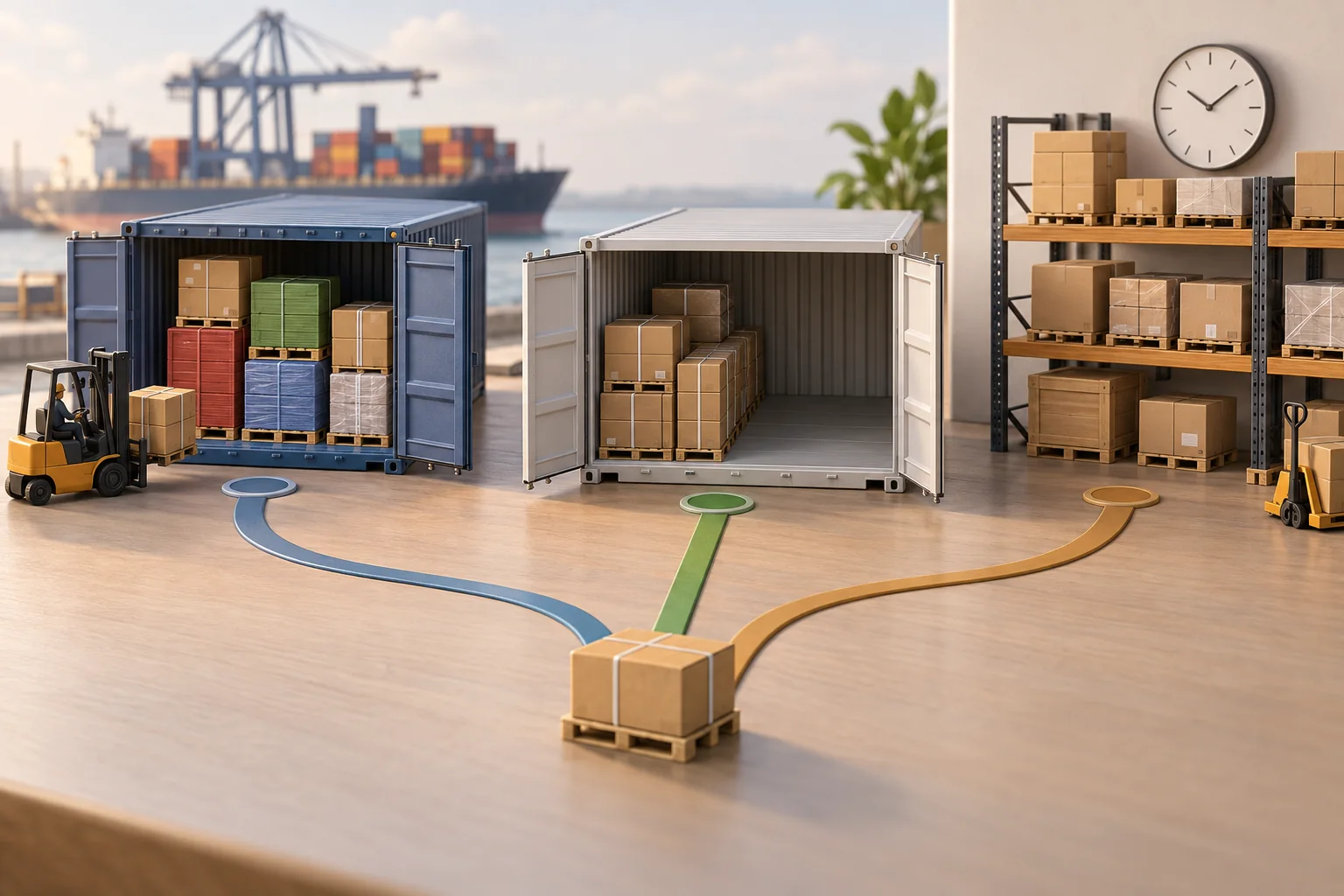
Work backwards from usable stock
Ask the person who needs the goods to define the meaningful deadline. Is it arrival at a port, release to a haulier, receipt at the warehouse, or stock checked and ready for sale? These are different events. A plan can meet a vessel-arrival target and still miss a customer commitment because delivery, unloading or receiving inspection has not been allowed for.
Build the timeline backwards from that final event. Identify the receiving appointment, local release steps, main transport, origin handover, document deadlines and supplier readiness. Request a route-specific schedule from the provider rather than applying a general number of days. Separate a confirmed cutoff from an estimated arrival and show where the plan has little tolerance for delay.
For the waiting option, put a decision deadline before the last workable origin handover. Agree what happens if the second supplier misses it: release the first shipment, switch to a verified alternative, or obtain an explicitly accepted later delivery. The person approving the wait should understand the consequence. “We will see next week” is not a fallback plan if next week removes the remaining options.
Compare costs over the same boundary
Decide where the comparison starts and ends, for example pickup of ready packed goods through delivery to the named receiving warehouse. Both options need that same scope. If one supplier price already includes a task, record it without charging the buyer twice. Conversely, an omitted cost is unknown, not zero. Our guide to comparing freight quotations explains how to obtain offers on a common basis.
DHL’s LCL cost guidance identifies weight or measurement and local origin and destination charges as relevant pricing inputs. For this decision, ask each provider to state its actual charging rules, minimums and exclusions for the shipment being compared.
Organize the comparison into origin, main carriage, destination and agreed optional work. Keep taxes and customs charges in the appropriate separate lines, with their basis confirmed for the destination; do not assume a change from LCL to FCL determines them. Mark each amount with a currency, validity date and supporting quotation. Where charges are conditional, write the trigger beside the amount so the eventual decision is understandable.
Keep cost responsibility separate from service choice
LCL and FCL do not by themselves tell you which party pays every charge or when sales-contract risk transfers. ICC’s Incoterms guidance explains why the chosen rule, named place and version matter. Confirm them in the purchase contract before allocating costs.
A practical comparison can contain two views: the total work needed for the movement, and the portion payable by the buyer. This helps identify a cost hidden inside the supplier’s selling price without pretending that it is payable a second time. Where a sales term and a freight offer seem inconsistent, ask for clarification of the exact task and handover point.
Use the existing Incoterms guide for China imports for that separate contract discussion. The decision record here should capture the agreed outcome: which scope is comparable, which party arranges each step, and which unresolved item could change the result. It should not rewrite the contract through a note in a shipping spreadsheet.
Treat waiting as a plan with its own costs
Waiting can be sensible when a confirmed later batch allows a better movement and the required delivery date remains protected. To evaluate it, list the expenses and commitments created by the wait. These may include agreed storage, another pickup, handling, revised booking charges or extra packaging. Ask the responsible supplier or provider for the applicable terms rather than estimating them from memory.
Then describe the business consequence of receiving the ready goods later. The right evidence may be existing stock, confirmed customer dates or a production requirement. Do not convert a vague fear of lost sales into a precise financial loss. Where the impact cannot be priced reliably, state it as a constraint or a separate scenario for the owner to review.
Check who is paying while goods wait and where responsibility for them sits. Also ask what evidence would make you stop waiting. A missed factory milestone, changed carton dimensions or expired quote can reopen the decision. A waiting plan is strongest when it has a named benefit, a bounded duration and a clear exit, even if the eventual choice is to send the first batch alone.
Check the packing plan, not just the empty space
A partly occupied container still needs a suitable packing and securing plan. The IMO/ILO/UNECE CTU Code is a non-mandatory global code of practice addressing cargo-unit packing and handling. Use competent packing advice for the actual goods and equipment.
Ask for a loading proposal that shows the package arrangement and identifies the party responsible for checking it. Photographs and dimensions are useful inputs, but an attractive drawing is not proof that a load can be secured safely. If crates cannot be stacked, tell the forwarder before relying on a volume-based comparison. The practical loading footprint may be the limiting consideration.
Hapag-Lloyd’s container-packing brochure discusses securing cargo and dealing with gaps. The buyer’s action is to obtain a reviewed plan, not to copy a generic securing arrangement. Refer to our container-loading and VGM checklist for the wider release record.
Keep the technical acceptance gate separate from cost preference. If the packer needs a different crate or additional securing work, update both the dimensions and the relevant offer. Do not approve the old comparison and hope that the packing change will be absorbed later. A modest change in the final package can alter the evidence on which the earlier decision depended.
Make additional handling a product question
Begin with the product’s real sensitivities: permitted orientation, moisture protection, stacking limits, inspection condition and how damage would be detected at receipt. Ask what each offered service requires the package to withstand and which handovers will be recorded. Avoid choosing a service solely because one headline says it is safer. You need a credible plan for the particular item.
Agree what the receiving team will photograph and count. Separate missing packages, visible packaging damage and hidden product defects in the record. A discrepancy process is easier to use when the parties know whom to contact and what evidence to preserve before anything goes wrong. The same discipline helps whether goods arrive as released pallets or in an exclusive container.
Insurance is a separate review. Use the cargo-insurance guide to prepare questions about the proposed cover, insured journey and exclusions. Do not count the full product value as a saving from choosing FCL, or assume that a policy eliminates every operational consequence of damage. Keep documented insurance terms and the buyer’s handling decision visible as different parts of the file.
Coordinate several suppliers without hiding readiness risk
When multiple suppliers contribute to one order, create a readiness line for each supplier. Include the expected package record, release condition, pickup address and evidence date. A single total volume can conceal the fact that the largest batch is still unfinished. Ask which goods are indispensable to the customer and which can arrive separately without disrupting use of the rest.
If a warehouse will combine the cargo, confirm receiving, counting, discrepancy reporting, storage and release instructions with the provider of consolidation and warehousing services. Decide who can authorize repacking and whether the finished dimensions will be remeasured. The comparison should use the final arrangement that the forwarder will actually receive.
Do not make every completed supplier wait automatically for the slowest one. First establish whether combining the batches creates a demonstrable benefit and whether the later readiness evidence is reliable enough. Equally, do not split a functional set without checking that the receiving team can use or store the first part. The shipment structure should follow the operational need.
A worked example using fictional comparison units
Consider a purely illustrative purchase: one batch of ordinary boxed goods is packed and ready, while another identified batch is due later. Assume for this example that the three proposed services accept the goods and their delivery plans have been checked. We use invented, currency-free comparison units. None of the figures below represents a market rate, a particular route or a quotation from China Moshaver.
| Compared item | LCL now | Partly filled FCL now | Wait, then ship together |
|---|---|---|---|
| Quoted movement within the same agreed scope | 100 | 112 | 96 |
| Additional storage caused by waiting | 0 | 0 | 6 |
| Additional collection caused by waiting | 0 | 0 | 4 |
| Comparable total in fictional units | 100 | 112 | 106 |
On these assumptions, the combined movement looks cheapest if the buyer reads only its freight line: 96. Once the two extra waiting costs are included, its comparable total is 106. The arithmetic is 96 plus 6 plus 4. Sending the ready cargo as LCL is lower by 6 units, while booking the exclusive container costs 12 units more than that LCL plan.
That does not automatically make LCL the correct purchase decision. Suppose the verified LCL availability date misses a customer requirement that the confirmed FCL plan can meet. LCL would then fail the timing gate, despite its lower total. Conversely, if both plans meet the deadline and the packaging review finds both acceptable, the file needs a specific reason to justify paying the FCL premium.
Now test one uncertainty rather than changing everything at once. If an omitted destination item adds 15 fictional units to LCL, its total becomes 115. The FCL total remains 112 only if its scope already includes that same required work. Under those revised assumptions, FCL is lower by 3 units. The missing line matters more than the appeal of either service name.
The example teaches a method, not a preferred result. Replace every invented number with a current written offer before making a real booking. Keep shared, unchanged costs out of an incremental comparison only when they genuinely remain identical across all options, and state that exclusion. If quantity differs between options, show total cash required and the relevant unit-cost basis so a larger purchase does not disguise its additional commitment.

Find the point at which your decision changes
A useful comparison asks more than which column is lowest today. Ask how much an uncertain charge or readiness delay could change before another option becomes preferable. In the example, the initial FCL premium is 12 fictional units. That gives the buyer a concrete question about missing LCL charges, rather than a general argument about which service is cheaper.
Test only plausible, documented changes: the final packed measurement, an identified destination charge, a revised supplier release date or the expiry of one offer. Record the current case and the changed case separately. Do not invent a probability of damage or a percentage chance of delay to make a spreadsheet produce an apparently precise answer.
This is also why a universal volume threshold is a poor booking rule. You can request LCL and FCL offers for the actual shipment and see where their comparable totals meet under the quoted conditions. A result from another route, month or package type may not transfer. The freight calculator can support preliminary planning, while a booking decision requires confirmed shipment data and scope.
Write a recommendation someone else can review
Keep the conclusion short enough to read without reconstructing the whole file. State the cargo version, the options considered, the chosen plan and the main reason. Add the cost difference, the required availability date, the confirmations obtained and the items still conditional. Name the person authorized to approve the commercial tradeoff and the person responsible for booking.
A clear recommendation might read: send the ready batch under the confirmed LCL offer because it meets the receiving requirement and has the lowest comparable total; reassess if the final packing measurement changes or the destination charge is revised. Another shipment may justify FCL because its accepted loading and receiving plan resolves a constraint that the offered LCL service cannot meet.
Preserve rejected options too, with their reason. This is especially useful after a schedule changes: colleagues can see whether the earlier choice was unreasonable or whether a new fact has changed the situation. The record should support learning without pretending that an estimate was a guarantee.
Use a final release checkpoint
Before booking becomes irreversible, confirm the final package record, readiness, acceptance, service scope, quote validity, dates, payment terms and receiving arrangement. Compare them with the version used to approve the decision. When a material field changes, reopen the relevant part of the comparison instead of silently replacing a number in the approved file.
IMO’s packed-container weight guidance makes verified gross mass a loading condition and assigns responsibility to the shipper as defined in the transport arrangements. Confirm who provides it for the booked container; an individual LCL package weight is not itself the container VGM.
After delivery, connect the decision record with actual invoices, receiving dates and discrepancies. The landed-cost control guide explains that later reconciliation. Here, ask the narrower learning question: which assumption mattered most to the choice, and which input should be obtained earlier next time?

Frequently asked questions
Can I book FCL when the container will not be full?
Yes, an FCL arrangement can use only part of the available capacity. Whether it is suitable depends on the accepted equipment and packing plan, the full quoted cost and the delivery requirement. Empty space should prompt a comparison, not an automatic rejection.
At what volume should I switch from LCL to FCL?
Use a shipment-specific comparison rather than a universal CBM number. Obtain both offers for the same final package record and delivery boundary, include the relevant charges, and test the physical and timing constraints. The result is valid for those conditions and that quotation period.
Should I wait for another supplier to finish?
Wait only for identified cargo with a supported readiness date and a benefit that survives storage, additional handling or collection, and the effect on receiving time. Set the latest decision date and a fallback before the current shipment loses its workable departure option.
Does FCL guarantee an earlier delivery?
No service label should be treated as a delivery guarantee. Compare the actual routing, departure, origin work, destination release and final receiving plan. Use the provider’s current offer and distinguish estimated dates from any expressly agreed commitment.
What if the cheapest offer has missing charges?
Mark the comparison incomplete. Ask the provider to confirm the missing scope and amounts, or present a clearly identified conditional scenario. An empty cost cell must not be treated as zero when the work is needed for delivery.
Can I use the same decision for my next order?
You can reuse the worksheet and the questions. Recheck the cargo, packaging, readiness, route, receiving constraints and valid quotations. A previous result is useful background, but it should not override changed facts in a later shipment.
What should I send for a project-specific review?
Send the packed dimensions and gross weight, package counts, commodity and handling requirements, supplier addresses and readiness evidence, the named destination and required receiving date, purchase terms, and any written LCL/FCL offers. Identify the later goods if waiting is part of the decision.
Sources and a practical next step
The official and carrier materials linked in the relevant sections explain container-service distinctions, cost inputs, packing guidance, sales-term responsibilities and VGM. They do not establish a current price or available service for your route. The decision worksheet, hypothetical example and review sequence are an editorial method for organizing your own evidence.
Start with the goods already ready and the date they are needed. Ask for feasible alternatives on the same scope, then document the cost and operational consequence of each. The result should be a decision your purchasing, logistics and receiving teams can all understand, with a clear condition for reviewing it again.



[…] Related guide: choosing LCL, partly filled FCL or waiting for more cargo […]