
How to buy from Alibaba with a clear product, price and handover
Compare like-for-like offers, identify the approved product and agree who checks and hands over the goods before you commit to an order.
Clear information for your next decision
A promising Alibaba.com listing is a starting point, not a finished buying decision. Before you order, identify the exact product, compare quotations with the same scope, check who will fulfil the order, and turn the agreement into a clear online order. Decide how the goods will be checked and delivered before committing money. A badge, attractive unit price or friendly conversation cannot answer those questions by itself.
This guide is for a business buyer preparing an initial or repeat purchase from a supplier in China. It follows the decisions between finding a product and accepting the batch. For the wider route, start with buying and importing from China. Your country, account eligibility and product requirements must be assessed separately; reading an English guide does not establish which services or payment options you can use.

Start with a buying brief that another person can use
Write what the product needs to do before searching for the lowest price. Include the intended use, material, dimensions, finish, quantity and packaging. Separate essential features from preferences. If you have a reference photograph, mark the relevant details rather than asking for “the same quality.” Two suppliers can reasonably interpret the same photograph differently, especially when the internal construction is invisible.
Give each variant a short reference. A different size, colour or accessory bundle should occupy its own line, even if all variants share one product page. Record whether the quoted unit means one piece, a pair, a set or a retail pack. The buying brief should allow a colleague to identify what is included without reopening a long conversation or guessing from the main image.
Also record the delivery country and city, intended order date, required documents and what remains undecided. A supplier needs to know whether you want existing stock, a modified product or development of a new version. Asking for all three in one vague inquiry makes quotations difficult to compare. A realistic brief can say that quantity is provisional while still defining the product precisely.
Use search and RFQ to build a manageable shortlist
Alibaba’s buyer sourcing guide describes product search and requests for quotation, or RFQs, as ways to contact sellers. Use either route to collect answers to a defined brief. A large response count is not a buying outcome; you still need to establish which offers describe the product you actually want.
Search using a product name plus a meaningful feature, such as material or construction. Save the listing URL, supplier name and date alongside your reference. Similar photographs do not prove that two offers come from the same factory, and different photographs do not prove different production. Treat the listing as an invitation to ask questions, not a complete specification or a guaranteed availability statement.
For an RFQ, remove private customer details and anything a seller does not need to quote. State the product requirements, variant quantities and destination information that affect the offer. Ask suppliers to identify deviations explicitly. A response that says “we can make it” without addressing the brief belongs in the unanswered column, even when the price is attractive and the reply arrives quickly.
Example inquiry: “Please quote the two variants in the attached specification separately, using the quantities and packaging listed. Confirm the selling unit, minimum quantity, preparation period and handover point. Identify any difference in material, dimensions or packaging rather than assuming a substitution is acceptable. Show sample and one-time preparation charges separately from the goods. The destination is stated in the brief; please mark any part of the offer that still needs confirmation.”
Keep a small working shortlist and explain why each supplier remains on it. One may have a suitable existing product; another may offer a useful modification; a third may still need to confirm its production role. Do not spend equal effort on every message. Progress the offers that answer your questions and close the ones whose unresolved differences undermine the purpose of the purchase.
Read supplier information as evidence with a scope
The official Verified Supplier explanation describes assessments by independent third parties and downloadable reports. Read the actual report, including its date, entity and assessed activities. The label is useful context; it does not replace checking whether this supplier can deliver your particular product and agreed order.
Ask who manufactures the quoted item, who issues the sales documents and who handles problems. A trading company may offer a suitable service, while a manufacturer may outsource part of the work. The practical question is whether the responsibilities and evidence are clear. A factory video is not evidence that every product displayed by the business is produced at that location.
Match the supplier’s explanation against the product category and documents you receive. A report covering one site or process should not quietly become proof for another. If there is a mismatch, ask for clarification before increasing your commitment. For a deeper review, see supplier and factory verification and define the checks needed for your order.
Notice how a supplier handles a difficult but reasonable question. Can it explain a material substitution, identify the sample version or correct an inaccurate quotation? Clear answers help you evaluate the working relationship. They are not a promise of future performance. Keep the evidence and the remaining uncertainty separate, so confidence in a helpful salesperson does not erase a gap in the purchasing record.
Compare the same offer, not just the unit-price column
Ask every shortlisted supplier to quote the same variant list, quantity and packaging. Request a validity date and identify estimates. If one supplier offers a stock item and another includes a new mould, printing or special packaging, the headline prices answer different questions. Bring those differences into the comparison before deciding which offer is cheaper or more suitable.
| Line in the offer | What to clarify |
|---|---|
| Product and quantity | Exact variant, unit, included parts and quantity per variant |
| Customisation | Artwork, tooling, sample approval and ownership of supplied files |
| Packaging | Retail pack, protective materials and outer-carton arrangement |
| Delivery scope | Named handover point, included work and excluded charges |
| Checks and documents | Inspection access, required records and responsibility for corrections |
Minimum order quantity may apply to the whole purchase, each size, each colour or a customised component. Ask which rule applies to your mix. A lower unit price at a larger quantity also means more money committed and more stock to manage. Use the MOQ negotiation guide for the detailed discussion rather than buying an unwanted quantity simply to reach a price tier.
Keep currencies visible and separate one-time charges from costs that repeat with every batch. If a conversion or delivery amount is provisional, retain that label in your comparison. Do not turn an estimate into a firm total by placing it beside confirmed figures. Ask which event fixes the final amount and who must approve a change before an order proceeds.
Consider the cost of making the product usable for your business. Relabelling, replacement packaging, extra inspection or a smaller acceptable quantity can change the result. These are planning questions, not reasons to invent a universal landed-cost percentage. Obtain the actual inputs for your product and route, then compare the offers using the same boundary and a clearly stated set of assumptions.

Use the sample to settle a specific uncertainty
Before requesting a sample, write the questions it needs to answer. You may need to check fit, finish, assembly, packaging or the interpretation of a drawing. Ask whether the sample comes from normal stock or has been prepared specially. Record the version and any differences from the intended production batch; otherwise a positive sample review can approve less than you think.
Keep an agreed reference and a short result sheet. “Approved” should identify what was checked, what remains open and which changes are required. If the supplier sends an improved sample, state whether it replaces the previous version. The product-sample guide covers that process in more detail. A sample decision should feed into the order description, not remain an isolated photograph in a chat.
For a repeat order, compare the new brief with the last accepted version. A familiar model name can hide a changed component, finish or packaging arrangement. Ask whether the material and production method remain the same and identify approved differences. Prior experience is useful evidence, but it does not remove the need to define what the next batch must contain.
Move the agreement into a clear online order
Before accepting an order, compare its product lines with your final brief. Check variants, quantities, price, packaging, documents, shipment commitments and attachments. Identify the latest approved drawing or sample by a reference that both parties understand. An attachment with several conflicting versions does not make the agreement clearer. Remove ambiguity before the order becomes the record against which performance is assessed.
Keep important confirmations in the platform’s order and message record. If you discussed a change elsewhere, ask the supplier to confirm the final wording in the relevant order conversation. Do not assume that an informal promise automatically updates an existing order line. Read the revised order yourself, and keep a dated copy of the version that you accepted.
Decide how changes will be approved. If a specified colour is unavailable, the supplier should know whether to stop, propose an alternative or wait for a revised order. A broad instruction such as “send something similar” can permit a result you did not intend. Make approval specific to the affected variant and quantity, with consequences for price and dispatch recorded together.
Check that the seller, order reference and payment instructions form a coherent record. If the beneficiary or payment route changes unexpectedly, pause and verify through a known communication channel and the order interface. Urgency is not an explanation for a mismatch. For coordination support, review purchasing and payment services and ask which responsibilities can be accepted for your actual request.
Understand Trade Assurance within the actual transaction
The official Trade Assurance overview connects order protection with an online agreement and payment through Alibaba.com. Check the options and conditions displayed for your transaction. Do not assume that a supplier’s badge covers every payment route or that an available service applies to every country, account and product.
Write the product outcome you require in terms that can be checked. “Premium quality” leaves too much open; an agreed model, material, dimensions, appearance reference and packaging are more useful. The right acceptance checks depend on the item. For technical or regulated products, obtain suitable specialist input rather than copying a generic checklist from a different category.
Read the current order-specific protection and claim information before paying, and save it with the order. Distinguish dispatch from delivery and a commercial refund from other forms of compensation. The official delivery-guarantee terms illustrate why a named benefit has its own conditions. Do not build your purchasing plan around an assumed universal refund or a fixed claim deadline taken from an old article.
Verify payment eligibility using your own accurate business and account information. A method mentioned on a public marketing page is not confirmation that you can use it. Do not borrow another person’s identity or treat a purchasing intermediary as an automatic way around account restrictions. If the available route does not support the intended transaction, resolve that issue before making a commitment.
Agree on inspection access before the batch is ready
Decide who will check the goods, where the check will happen and what evidence you expect. Counting cartons, checking visible damage and testing product function are different jobs. Ask how a reviewer can identify the relevant batch and whether the goods will be accessible. A sealed stack of cartons is not the same as a completed product inspection.
Define what happens when a problem is found. The affected quantity may need to be held, reworked or presented again for review. Agree who decides and how the corrected goods will be identified. A report alone does not implement a solution. The quality inspection service is a relevant starting point when the required work goes beyond an ordinary receipt check.
Keep the inspection question proportionate to the risk. A simple visual review cannot establish every technical property, and a document cannot prove that every shipped unit matches a sample. State the limits of each piece of evidence. This helps you decide whether to proceed, request another check or change the purchasing plan without overstating what has already been established.

Join the supplier’s handover to the rest of the route
Write the handover address, contact, reference and included work clearly. Ask who arranges collection, provides transport documents and responds if the goods are not ready. Product dimensions alone are insufficient for a shipping estimate; obtain the number of cartons, gross weight and packed dimensions. If these remain estimates, keep them provisional until the packed batch can be measured.
For several suppliers delivering to a warehouse in China, keep each order identifiable. The receiving team needs a variant list, expected package count and instructions for discrepancies. Decide whether incomplete or disputed goods can be included in the final shipment. Consolidation and warehousing covers a different scope from buying the goods; agree that scope rather than assuming it is part of the supplier’s offer.
Check destination requirements using the actual product and importing party. A seller’s willingness to ship is not proof that the documentation or market-entry requirements are satisfied. Avoid treating a delivery term as a substitute for checking who will carry out each task. If the route or packaging changes, revisit the quotation and responsibility list instead of carrying old assumptions into the shipment.
Check the received goods while the evidence is still available
Connect the receipt record to the order lines. Note what arrived, what was checked and what could not yet be checked. Photograph relevant labels and packaging before changing them. If there is a discrepancy, identify the affected variant and quantity; a general photograph of a mixed pile rarely explains which part of an order is wrong or missing.
Keep accepted goods and unresolved goods distinguishable. Do not quietly offset a shortage of one variant against an excess of another unless the buyer approves that change. Record the supplier’s proposed remedy and what it actually covers. A replacement promise, a platform claim and a completed refund are separate events, and the order record should make their status clear.
Follow the current claim route and deadlines shown for your order. Preserve messages, the agreed specification, inspection evidence and delivery records, and explain the difference between the agreement and the result. Do not wait for an unrelated international delivery milestone if the transaction requires earlier action. A documented claim supports review; it does not guarantee a particular decision or recovery amount.
Example: two sizes of an unbranded display stand
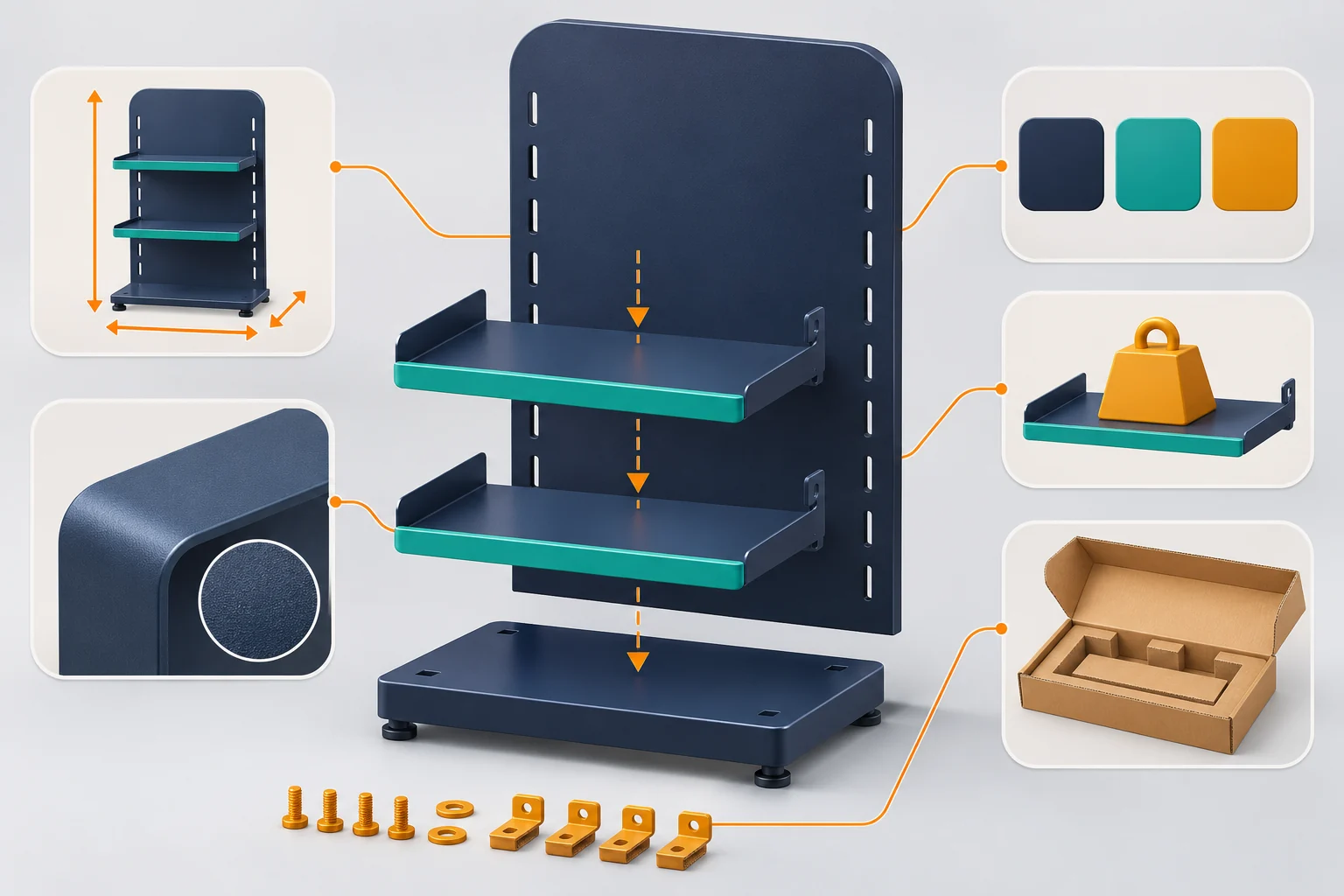
Imagine a retailer preparing a fictional order for 240 countertop display stands in two widths. One supplier quotes an existing model; another includes a revised base; a third excludes retail packaging. There is no useful cheapest-offer conclusion yet. The buyer first asks each supplier to price the same width mix, base design, finish and packaging, with deviations stated on separate lines.
The sample reveals that the revised base occupies more shelf space. The buyer changes the brief, approves a labelled reference and asks for the online order to name that version. Before production is released, the receiving and inspection responsibilities are agreed. When one width later shows a packaging mismatch, the affected quantity stays identifiable while a written remedy is discussed.
The example contains no real customer, current price or promised result. Its purpose is to show where a purchasing decision becomes stronger: comparable offers, a traceable approved version and a clear response to a discrepancy. If the same goods will supply an online store, inventory planning is a separate task; use the Shopify and TikTok Shop inventory guide for that boundary.
Questions before placing an Alibaba order
Does a Verified Supplier badge guarantee my order?
Use the report as evidence about its stated entity, date and assessed activities. Check the particular product, production role and order conditions separately. A badge does not replace an agreed specification or batch checks.
Can I compare Alibaba and 1688 by listing price alone?
No useful comparison is possible until product, quantity, payment, delivery and service responsibilities match. The 1688 buying guide covers that platform’s purchasing route. Compare the actual offers you can use, including their unresolved conditions.
Should I confirm receipt before checking the goods?
Understand what the confirmation means in your current order and complete the checks you need before making a statement about receipt or acceptance. If something is wrong or unavailable for inspection, use the appropriate current order process rather than recording an inaccurate confirmation.
What should I send for an initial review?
Send the listing, selected variants, quantity, destination and current supplier offer. Identify the help needed: sourcing, purchasing coordination, inspection or handover planning. The request review form lets you describe that scope without assuming a price, payment method or service commitment.
Choose the next action from the missing information
If the product is still vague, improve the brief. If quotations differ, make them comparable. If the supplier’s role or payment route is unresolved, settle that before committing money. For a search that needs more structure, review supplier sourcing services. The useful next step is the one that removes a specific uncertainty from your real order.
Ready to review your own order?
Share the product link or photo, quantity, destination country and city. Tell us which stage you need help with.
Request an initial review