
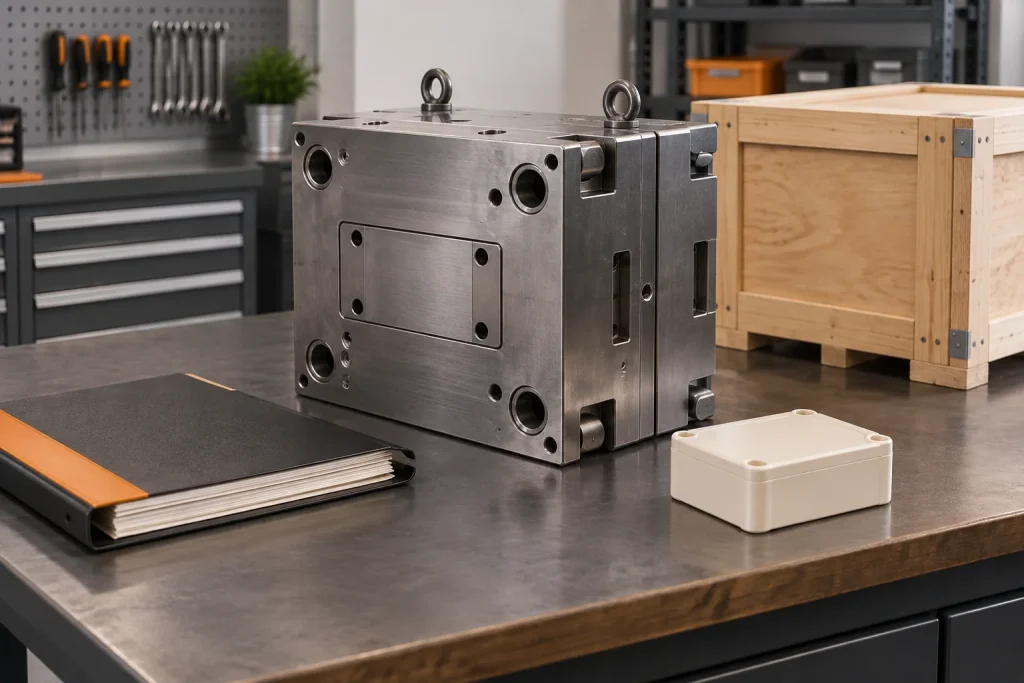
Prepare an injection mould handover from China: condition evidence, usable files, accessories, receiving-factory readiness and separate production approval.
Make the handover specific before you book the move
Define what will be handed over, identify the mould and record its current condition. Check usable files, associated items and the receiving factory before arranging movement. Treat physical receipt and approval to produce at the new site as separate decisions.
“Send us our mould” sounds like a straightforward instruction. It can conceal very different expectations. The current factory may mean the steel assembly on its shelf. You may expect inserts, project spares, usable drawings, a record of changes and enough information for another factory to assess the job. Nobody benefits from discovering those differences after the transport crate has arrived. A useful handover starts by turning the request into a defined set of deliverables and decisions.
This guide concerns the buyer’s coordination of a plastic injection mould handover from a Chinese factory. It does not prescribe machine settings, installation steps or a legal form. Engineers and other appropriate specialists decide those matters for the actual equipment and project. Your task is to keep the identity, evidence and open questions connected. If the project is still deciding what to commission, read the OEM, ODM and private-label comparison first. Here, an identifiable mould already exists and the question is how to prepare its handover and a move.
Separate four outcomes that people often call “transfer”
Use four separate outcomes in your project file: an agreed basis for release, a defined assembly and associated deliverables, physical receipt of that assembly, and a decision about production at the new site. Each outcome answers a different question. A carrier receipt can document a movement without proving completeness. A complete inventory can establish what arrived without proving that the new production cell is ready to use it.
Name the evidence needed to close each stage. Release may depend on reviewed agreements and confirmation by the relevant parties. Identity depends on records that can be matched to the asset. Receipt requires an appropriate condition and inventory check. Production approval requires the receiving team’s review and the agreed product evidence. This is a coordination framework for your project, rather than a claim that every business must use a particular document.
Assign each decision to someone able to make it. The person arranging collection need not decide physical title, installation safety or product acceptance. One coordinator can maintain the file while different people approve their respective scope. For the underlying commercial obligations, use the Chinese-supplier purchase contract checklist. The present workflow follows those obligations into an actual handover instead of repeating contract drafting.
Resolve release authority before relying on a collection date
Bring together the mould order, relevant payment records, agreed asset description and release terms. Check who is named in each document. The supplier selling the product, the factory running production and the company holding the mould may be different parties. Find out who can confirm release and who is responsible for the accompanying deliverables. A friendly answer from the sales representative is a useful contact, but it may leave those responsibilities unresolved.
WIPO’s supplier guidance recommends written clarity about rights, future use and copies of deliverables. Paying a tooling charge does not answer every handover question.
If a balance, ownership issue or permission remains disputed, record that issue honestly and identify its review route. Do not make the transport plan depend on silently assuming it has been settled. You can still carry out permitted, independent work such as identifying documents or clarifying the asset list. Separate preparation from authority to move. Where the agreement is unclear, obtain the relevant professional advice rather than asking a driver or warehouse employee to resolve the dispute at collection.
Connect the mould identity to the product revision
A nickname is not a reliable asset identity. Ask the current custodian to show the identifier used for the mould and relate it to the product and drawing revision. If your company uses a different internal number, record the relationship between both numbers. Avoid replacing the old identity in a way that disconnects repair records or earlier samples. Someone reviewing the file later should be able to follow the history without relying on the original project manager’s memory.
Record the whole assembly and any significant separately identified components. General photographs, the identifier and appropriate component references help establish that everyone is discussing the same item. The necessary photographs should be taken by authorised people in safe conditions. The buyer is not being asked to open machinery or dismantle the mould remotely. A photograph of the main block also does not establish that all project inserts or accessories are present.
Where the mould has been modified, identify the current state explicitly. An earlier drawing may still be useful history, but it should not be presented as the current configuration simply because it is the easiest file to find. Put the applicable product revision, physical identity and supporting evidence together. That connection becomes particularly valuable when the receiving factory did not participate in the original development.
Build an inventory of deliverables, including exclusions
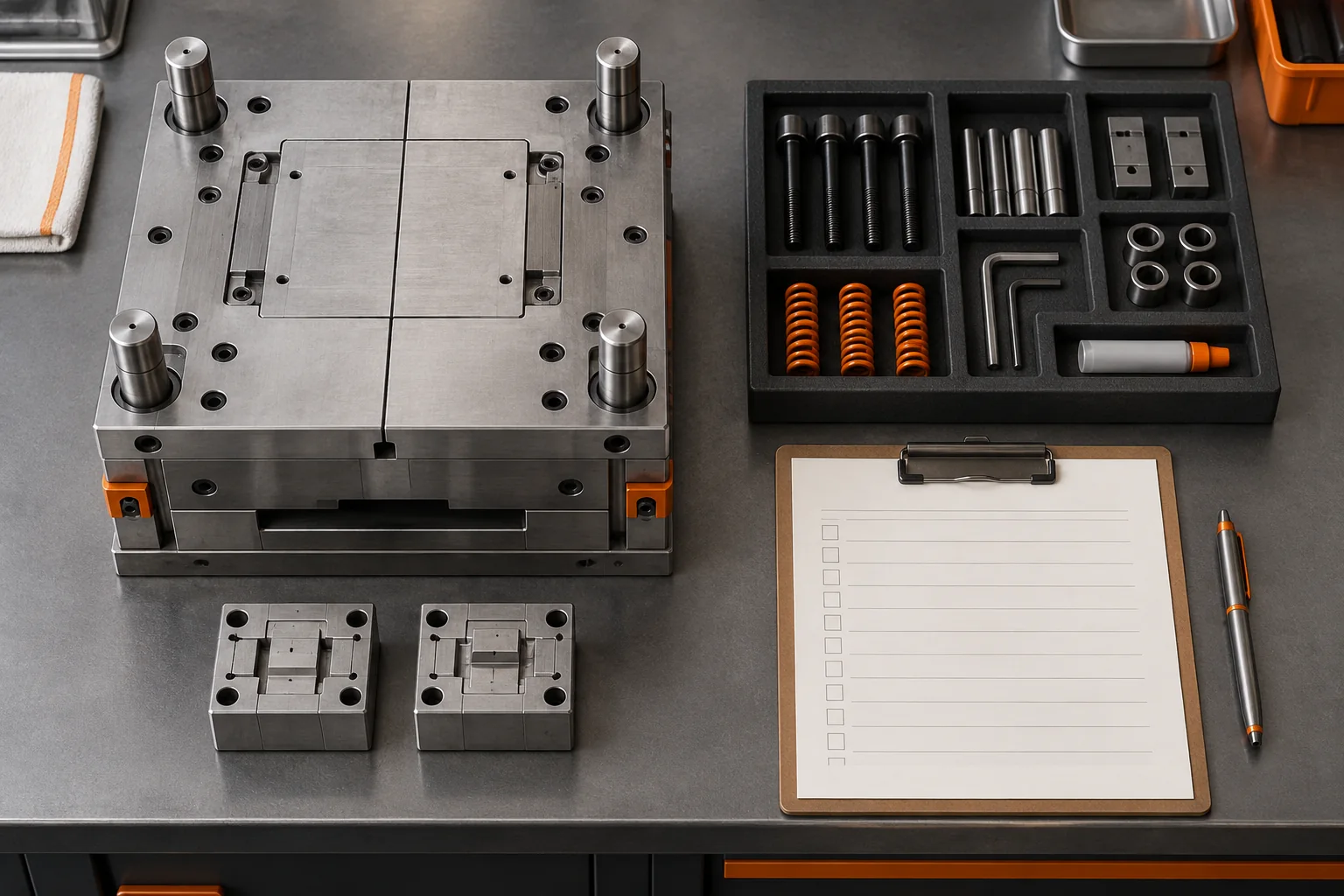
Replace “mould with accessories” with an inventory that can actually be checked. Include the assembly, agreed inserts, project-owned spares and any dedicated associated items that form part of the handover. Do not automatically include shared factory equipment because it was used during production. A controller, fixture or other item might be part of the agreed package, an available option or something that will remain at the old site. Establish which description is correct.
For each item, record its reference, expected quantity, present status, evidence and intended package. An unknown quantity should stay unknown until checked. Entering zero would suggest that somebody established the absence of the item. Entering “complete” without a defined list is equally unhelpful. Clear unknowns create a practical follow-up task instead of a false sense that inventory work is finished.
Include an exclusions column. It allows the receiving team to see what it must provide or assess separately. If a missing item has an alternative, record who will check that alternative and what evidence is required. The list should remain about this particular handover, rather than becoming a catalogue of every possible injection-moulding accessory.
| File area | Question to close | Useful evidence |
|---|---|---|
| Identity | Which mould and product revision? | Identifier, images and revision link |
| Contents | What arrives, and what stays behind? | Agreed inventory and package match |
| Files | Can the receiving specialist use them? | Revision, format and access result |
| Condition | What was examined, and what was not? | Scope-limited condition record |
| New site | Who reviewed readiness? | Technical response and open questions |
Establish present condition instead of relying on past success
“It made good parts last year” describes an earlier production result. You need to know what evidence exists for the assembly being released now. Locate the last-use record and any subsequent storage, repair or alteration information. If nothing reliable is available, say so. A missing record is an open question, not a reason to invent a clean history or a remaining service life.
Ask the appropriate specialist to define the condition review. What was observed, what records were examined and what remains outside the review? An external appearance check, an operating assessment and a product-output test are different scopes. Name the actual work so that a neat photograph does not turn into an unsupported claim of complete technical health.
Record reported corrosion, damage or other concerns by location and evidence, without diagnosing the cause from a picture. An observation and an engineering explanation belong in different fields. When arranging quality inspection support, request a specific, reviewable scope. “Guarantee that the mould is perfect” gives the specialist much less useful direction than identifying the decisions and evidence your handover needs.
Make changes and repairs traceable to the outgoing configuration
The mould, drawings and samples may have evolved together over several orders. Ask which significant changes apply to the outgoing configuration and where they are recorded. If an insert was replaced, the relevant document and sample should not still point to the earlier part without explanation. Extra photographs do not repair a broken revision link; they may simply make the file larger.
Separate an approved modification, a recorded repair and an unresolved proposal. State the evidence and the person responsible for review. Do not infer remaining life from the number of repairs alone. If work will be done before collection, identify when the condition baseline will be updated. Otherwise the departure record could refer to the assembly before a final intervention rather than to the item that actually leaves.
Meusburger’s service description includes component checks, reports and trials for its systems. It illustrates documented specialist work, not a universal mould maintenance interval or acceptance method.
Test file usability while both factories are still available
A folder with many attachments can still be unusable. Give each file a title, revision, format and intended purpose. A viewing document, an editable drawing and data read by a particular control system serve different jobs. Let the receiving specialist identify what it needs and what it can actually open. Keep that response in the handover file rather than relying on “documents sent” as the final status.
Conduct a permitted access check before committing the move to a fixed restart date. Ask for a specific result: the file opens, the revision is recognisable, the information is adequate for the defined review, or something remains missing. Dependencies on software, licences or additional files should become visible here. Being able to download a file is not the same as being ready to use it for the intended engineering task.
WIPO distinguishes licensing from assignment of intangible rights. File receipt, technical usability and permission for the intended use therefore need separate attention; no automatic legal transfer is assumed here.

Preserve production context without treating it as a plug-in recipe
Ask the technical team what prior production information will help the new site assess the job. Relevant records may identify the equipment, product revision, material and existing test evidence. These are reference inputs. The buyer should not instruct the new factory to run an old settings file unreviewed on different equipment. The receiving specialists decide what can be used and what must be checked again.
ARBURG’s ALS documentation illustrates records connecting mould, machine, material and peripheral equipment. That specific system description does not require your project to buy the software or copy settings without review.
Label prior-site information as reference information. Label the new site’s approved records separately once they exist. If the receiving team uses an old trial to propose a new review, retain the proposal and its limits. For scheduling, connect these decisions to the production lead-time and dependency plan. A proposed start date should not quietly assume that unresolved technical inputs are already available.
Ask the receiving factory to review the file before dispatch
Introduce the receiving specialist early enough to identify missing information. Record who reviewed which documents and the response date. “Send it over and we will see” may be an offer to accept a delivery, but it leaves production readiness open. Storage arrangements, a technical review and a planned trial can have different readiness states. Keep them separate instead of making the transport booking stand in for all three.
Request specific questions about the intended equipment and associated items. Dimensions, mass, interfaces and other project data must come from reliable records or appropriate checks, not a guess from the cover photograph. This article provides no machine capacity, connection method or lifting prescription. It explains how to capture the competent team’s answer and preserve unknowns until they are resolved.
A useful receiving response distinguishes information accepted for review, missing evidence, proposed changes and the person who will approve those changes. If an answer is “probably suitable”, retain that uncertainty. Do not rewrite it as approval in the project schedule. Discovering a dependency before dispatch gives the parties an opportunity to address it while the mould and its records are still accessible at the current site.
Coordinate the last production activity and the departure baseline
Identify open orders and decide which activities remain permitted before release. If the mould will still be used, the condition evidence needs an appropriate relationship to that last activity. A photograph taken before the final repair or run might not describe the outgoing state. Build a simple chronology so that the team can see when each record was made and what happened afterward.
Define the reference samples appropriately. Connect each sample to the product revision and whatever production context the technical review requires. A sample retained for appearance should not silently become evidence for every functional property. Selection, quantities and test requirements belong to the relevant specialist’s plan; the coordinator preserves the connection between samples and results.
If the transfer conflicts with the next delivery promise, show the dependency. Do not promise immediate collection while also assuming unlimited further production on the same assembly. The parties need to decide how to complete, stop or reschedule the affected work. These are execution choices within the actual project, not reasons to invent a generic lead time or an extra tooling capacity.
Match the packing record to the asset that leaves
Have appropriate specialists arrange packing, handling and transport using verified project information. Avoid estimated mass or dimensions. Establish who decides protection, the handling arrangements and the route conditions. The final inventory should connect to the actual packages. If accessories travel separately, the receiving team needs to know where to find them and how those packages relate to the main assembly.
At handover, record the identified items, observed condition, package references and responsible parties. The evidence should concern this departure, rather than an earlier shipment with a similar crate. Resolve discrepancies between the agreed list and the packed list before signing a vague declaration that everything is complete. A receipt should confirm only the checks that were actually performed.
Factory departure closes one stage. Keep transport references and subsequent handovers connected to the same file. Agree where a receiver should report an observed shortage or damage. Use appropriate advice for carriage, insurance and customs documents; no price, coverage or destination requirement is assumed in this workflow.
Record physical receipt without prematurely accepting performance
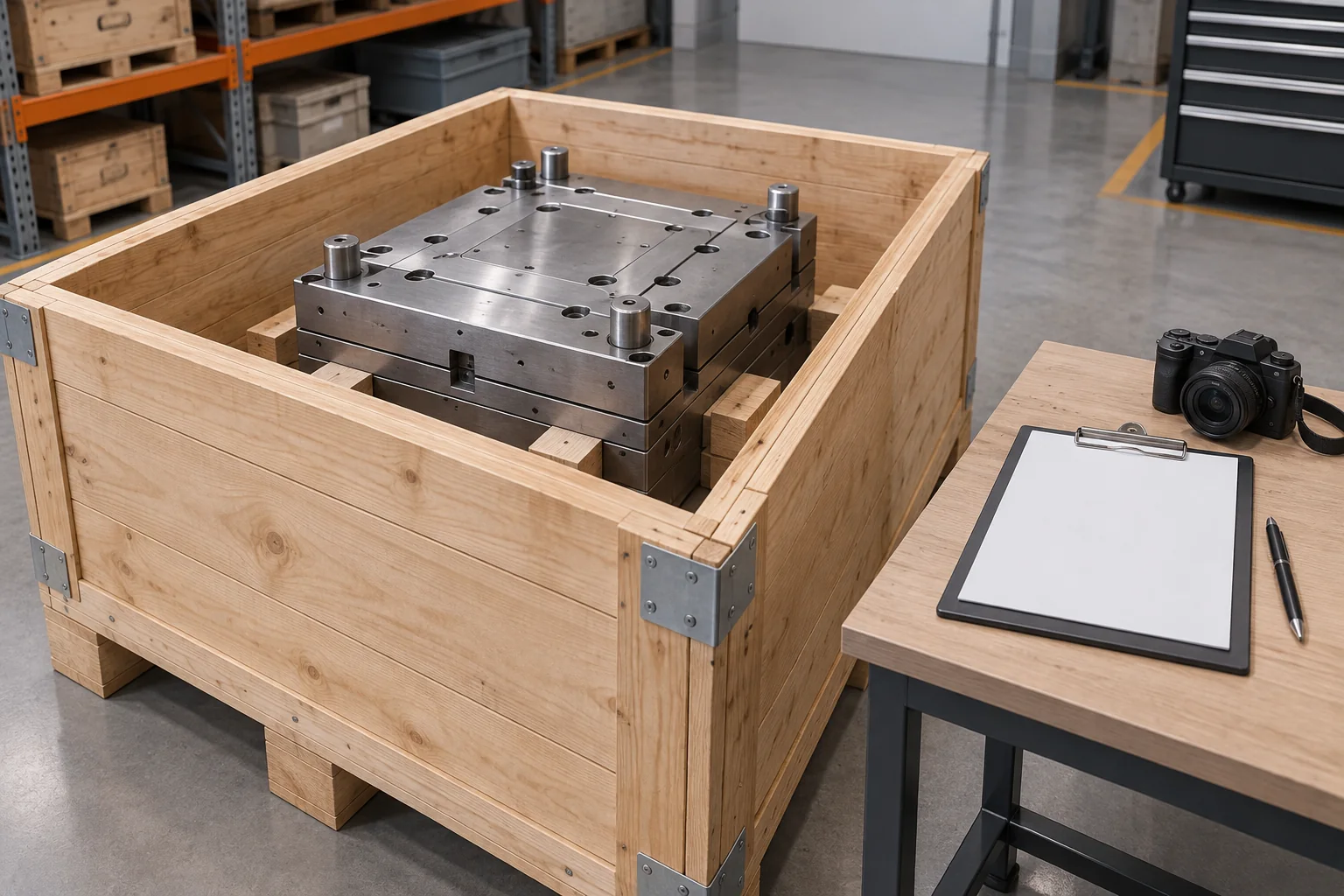
At the receiving site, record delivery first and then the relevant inventory and condition checks. An intact outer package can coexist with a missing accessory. A complete assembly can arrive before any technical examination has happened. Use statuses that reflect these differences: package received, inventory matched, condition review completed, or production approval pending.
If something does not match, preserve the initial observation, timing and examined scope. Do not immediately decide whether it resulted from transport, an earlier condition or an action after arrival. Departure and receipt evidence should be comparable. The competent team should decide the sequence of examination, cleaning or repair; the coordinator records it so that an initial condition is not lost behind undocumented interventions.
It is reasonable to close physical receipt while leaving a defined technical question open. The document should explain that boundary. A warehouse confirmation must not accidentally imply that the tool can already produce every required item. State the next decision, its owner and the expected evidence so that the unresolved issue has a clear route forward.
Make new-site production approval a distinct decision
Installation and preparation belong to competent people working with the applicable equipment instructions and site conditions. The buyer’s handover file provides information; it does not replace their safety or technical assessment. A deadline is not a reason to bypass the receiving team’s checks because the mould previously worked elsewhere.
HSE’s injection-moulding guidance addresses safeguards and operator checks, including after mould changes. It is UK guidance, not Chinese law or the instructions for your particular equipment.
Before a production trial, ask the receiving specialists to define what they will examine and what evidence will support a decision. Changes to the equipment, material or working method should be visible in that plan. The purpose is not to make every detail identical to the old factory. It is to understand the proposed new configuration and evaluate the intended result appropriately.
Compare parts against an agreed reference, using a credible method
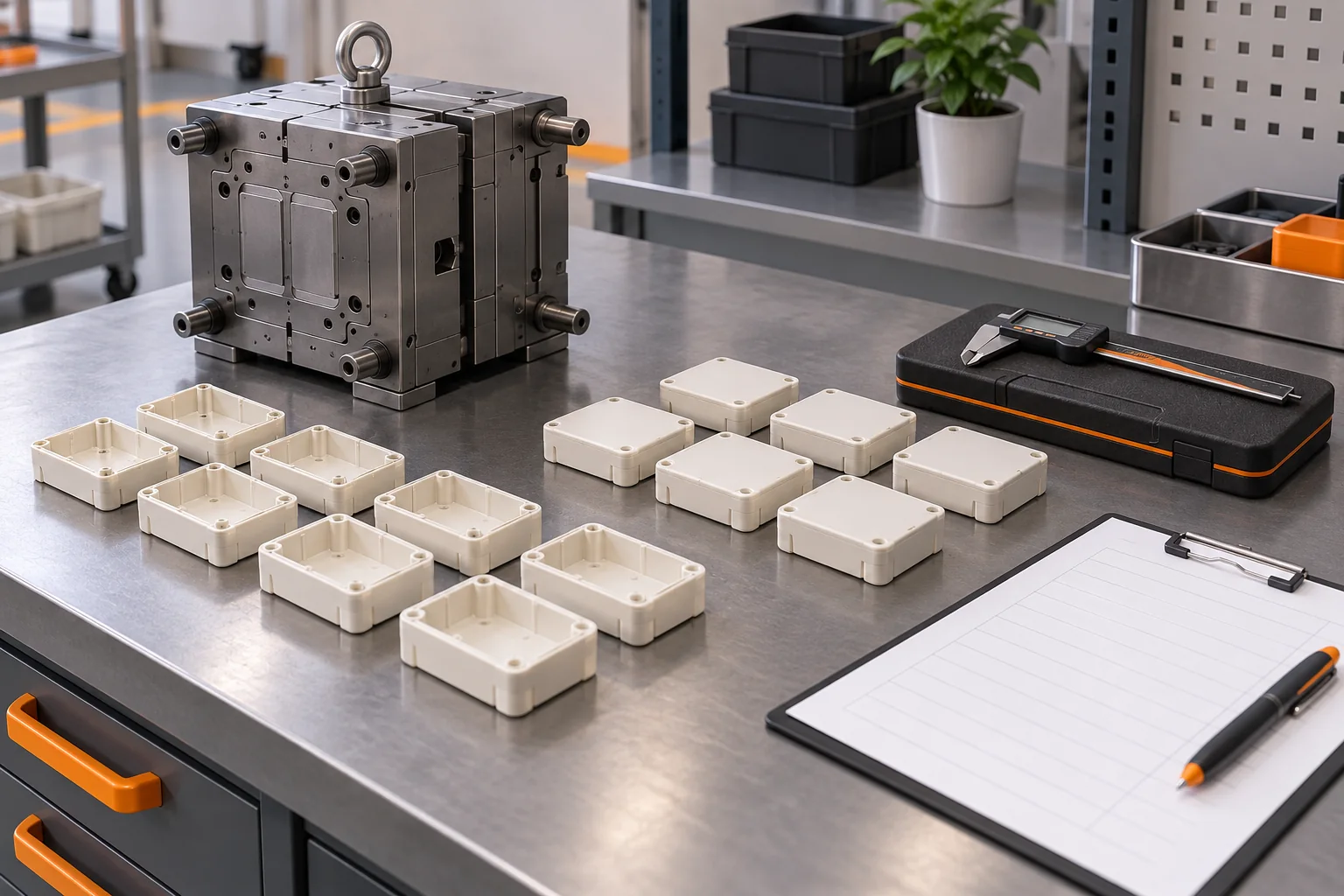
Supply the current product specification and appropriate reference evidence to the quality team. The mould’s name is not a part-acceptance criterion. Important characteristics, examination methods and recording arrangements need to be defined. Where the mould has several cavities or interchangeable parts, ask the specialist how results will remain connected to the relevant source. No universal sample count or acceptance threshold is prescribed here.
NIST’s measurement-system guidance considers instruments, operators, configurations and variation. A difference between two sites’ readings should not immediately be attributed to the mould without examining the measurement method.
Keep an unexpected result together with its trial context. Avoid a succession of undocumented adjustments that leaves nobody able to explain what changed. The technical owner directs investigation and any corrective work; the project file preserves the result, action and later decision. The pre-shipment inspection and acceptance guide concerns a related but different decision. New-site tooling approval and acceptance of each subsequent shipment should remain distinguishable.
Give the right people the information they need
Define the authorised recipient and purpose for each information package. A transport coordinator generally needs different information from the receiving engineer. Avoid distributing all drawings indiscriminately, but do not leave the technical team hunting through unrelated contacts for essential documents. An organised file supports appropriate access while making the applicable revision easy to locate.
WIPO identifies reasonable secrecy measures among the general criteria for trade-secret protection. The rights and obligations concerning any particular project file still require case-specific assessment.
Do not assume that every document held by the factory is freely transferable. Some information may belong to another party or depend on an equipment-provider arrangement. Raise the issue before the handover date and obtain a permitted solution from the relevant party. An alternative document, controlled access or a different deliverable may be needed. Record that dependency openly instead of hiding it by renaming a folder.
A hypothetical example: the mould arrived, but the project remains open
Consider a buyer moving a mould for a plastic enclosure to another factory. This is an invented teaching example, not a client case. The agreed package contains the mould, specified inserts and drawings. Before dispatch, the receiving engineer can open a viewing file but reports that an additional usable engineering deliverable is still missing.
The project now has two different states. Physical identity and the outgoing inventory can be reviewed. Engineering information remains incomplete for the intended review. If the responsible people choose to move before that dependency is resolved, record the decision and its consequences. Do not describe all documentation as complete just because the metal assembly can be transported.
On arrival, the warehouse matches the inventory. The receiving technical team then reviews the new configuration and arranges the appropriate product evidence. If a result does not meet the agreed reference, the production decision stays open. Receipt may have succeeded while production approval remains pending. This distinction helps the parties address the actual issue instead of treating every open question as proof that the entire transfer failed.
Questions buyers ask about a mould handover
Does paying for the mould give me an immediate right to collect it?
Payment alone does not settle every release question. Review the agreement, responsible parties, identified asset and unresolved conditions. Release authority, practical collection and rights in accompanying files need separate attention and appropriate advice where disputed.
What should the initial handover file contain?
Start with the mould identity, product revision, current location and custodian, agreed contents, condition and change evidence, available files and proposed receiving site. Mark missing information as unknown and assign a follow-up owner.
Can the new factory reuse the old settings directly?
The receiving specialists decide what is suitable. Prior information is a review input, not automatic approval for another machine, material or production cell. Readiness and the trial plan should be established before production.
Is a clean-looking mould enough evidence of readiness?
Appearance describes the scope of an appearance check. Completeness, technical condition and product results require their own appropriate evidence. Do not turn a clear photograph into a claim that every technical question has been answered.
What should a warehouse receipt confirm?
Only what was actually checked, such as delivery, outer condition or inventory. If performance has not been evaluated, say so explicitly and keep the production decision separate.
Is an openable drawing sufficient for handover?
Check revision, information adequacy and permitted use as well as access. A file may be suitable for viewing but inadequate for the receiving specialist’s intended engineering work.
When can the transfer file be closed?
Close the defined handover scope when delivery, receipt and outstanding questions have been addressed with the agreed evidence. Record the receiving team’s result accurately. Physical handover closure does not approve every future production order.
Leave a file that another person can understand
A practical handover file explains which mould is moving, what accompanies it, what evidence describes its condition and which decisions remain open. A new team member should be able to follow that account without the original manager standing beside them. More attachments do not automatically improve the file. A clear inventory, connected revisions and visible stage decisions are more useful than a large unexplained folder.
Prepare the identity, product revision, current location, files, associated items and receiving-site information for a supplier coordination review. State the requested scope clearly: obtaining a document, coordinating a specialist check, matching contents or preparing a handover. The China buying and import guides provide the surrounding workflow. Whatever becomes clear today should remain easy to find when the mould actually moves.
Sources and limits
The linked primary sources support limited statements about rights, documentation, safeguards and measurement. The project-file structure, coordination sequence and hypothetical example are original procurement guidance. They are not an installation procedure, technical standard or legal certification. Applicable equipment documents and competent project-specific review govern the actual work.