
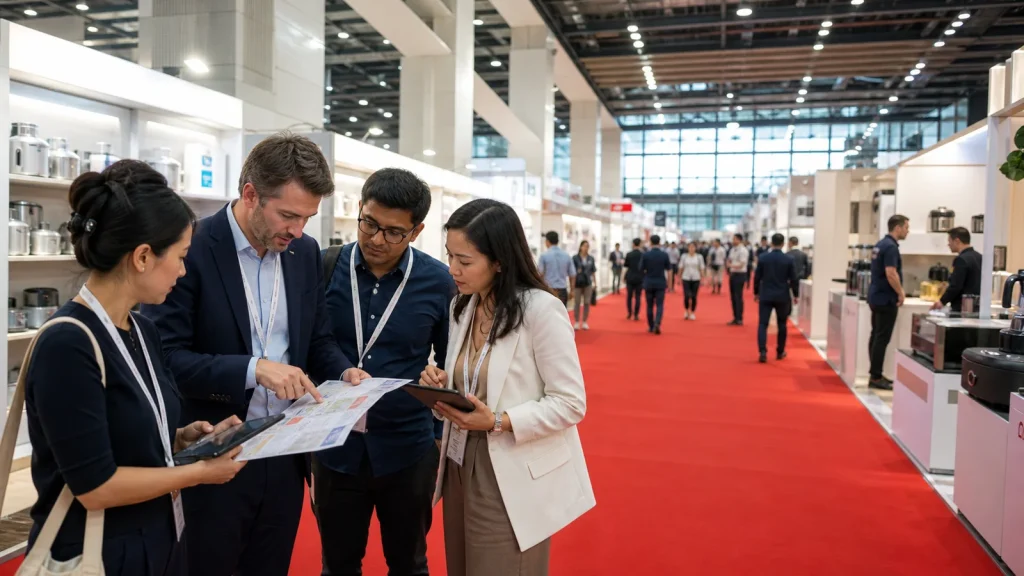
Turn the 140th Canton Fair from a crowded visit into an evidence-led buying mission covering phase choice, meetings, samples, verification and follow-up.
The 140th Canton Fair is scheduled in Guangzhou in three product phases: 15–19 October, 23–27 October, and 31 October–4 November 2026. A productive buyer does not treat those dates as one enormous browsing trip. The practical sequence is to select the phase that actually contains the target product, pre-register through the official Buyer Service System, build a short exhibitor list, book decision-focused booth meetings, preserve evidence, and move only the strongest candidates into samples, verification, factory visits, quotations and a controlled purchase process.
This guide is written for importers, distributors, private-label buyers and procurement teams. It explains how to turn fair attendance into a comparable supplier file without pretending that a booth, badge, invitation letter or friendly conversation proves manufacturing capacity. Official arrangements can change, so check the current Canton Fair portal again before buying tickets, applying for travel documents or relying on a registration location. Prices, visa outcomes, freight costs and supplier performance are deliberately not invented here.
The short answer: build a buying mission, not a walking tour
- Define the product, destination-market requirements, target annual volume and commercial boundary before choosing a phase.
- Confirm the current phase dates and product sections on the official website, then reserve travel with realistic arrival and recovery time.
- Register or sign in through the official Buyer Service System; request the buyer badge and invitation only through current official channels.
- Create an A/B/C exhibitor list: booked priorities, walk-in comparisons and optional market-learning booths.
- Use one meeting sheet for every supplier so price, MOQ, capacity, material, lead time, quality controls and legal identity remain comparable.
- Photograph and label samples and evidence only with permission; record the booth, company, contact and promised follow-up in the same record.
- Score suppliers every evening, request missing evidence, and schedule factory visits only for candidates that survive the first screen.
- After the fair, verify the legal entity and factory, test samples, normalize quotations, agree specifications and control payment before ordering.
The fair is one stage inside a larger sourcing system. The China purchasing and import guides provide the hub for adjacent decisions, while the guide on how to start importing from China places supplier discovery, product compliance, costing, logistics and customs into the correct sequence.
140th Canton Fair dates, venue and operating facts
The official 140th-session pages list Phase 1 for 15–19 October 2026, Phase 2 for 23–27 October, and Phase 3 for 31 October–4 November. The official fair page states daily trade hours of 09:30–18:00 and gives the China Import and Export Fair Complex address as No. 382 Yuejiang Zhong Road, Guangzhou. It also identifies the organizers as the Ministry of Commerce of the People’s Republic of China and the People’s Government of Guangdong Province, with the China Foreign Trade Centre operating the event.
These dates create two non-show intervals: 20–22 October and 28–30 October. A buyer attending adjacent phases can use those days for factory visits, sample consolidation, team reviews or relocation, but only after allowing for travel time and confirming that a factory can receive visitors. Do not schedule a distant factory visit immediately after a full exhibition day without accounting for traffic, check-in, security, meals and note processing.
The current official homepage describes 13 categories and 54 exhibition sections. Section naming and hall placement can be refined before opening, so the official searchable exhibitor and product directory should be the operational source—not an old floor plan saved from another session. Put a “checked on” date beside every schedule, map and registration instruction in the trip file.
Choose the correct phase from the product, not from travel convenience
Phase 1: advanced manufacturing and industrial buying
Phase 1 is the starting point for buyers of electronics and household electrical appliances, industrial automation and manufacturing equipment, vehicles and two-wheelers, lighting and electrical products, hardware and tools, and related advanced-manufacturing categories. A buyer of an electrical consumer product may still need more than one section because the finished item, its components, its packaging machinery and its testing equipment can sit in different areas.
Phase 2: quality home and built-environment categories
Phase 2 concentrates on housewares, gifts and decorations, building materials, furniture and related home categories. Product boundaries matter: a decorative light may belong with lighting in Phase 1 while a non-electrical decoration belongs in Phase 2. Use the official category list and exhibitor search to resolve borderline products before booking a one-phase trip.
Phase 3: health, lifestyle and consumer categories
Phase 3 covers categories such as toys and children’s products, fashion, home textiles, stationery, health and recreation products, food, personal care and pet products. These categories can carry strict destination-market requirements. Decide in advance which claims, test reports, labeling rules, ingredient or material restrictions and age-grading evidence must be discussed; do not accept “export quality” as a substitute.
If a portfolio spans phases, separate the business case for each. Attending every phase is not automatically better. Compare the value of additional candidates and market intelligence with extra hotels, travel days and management time. A focused single-phase mission with prepared meetings may produce more reliable decisions than three phases of unsorted contacts.
Write a one-page product brief before searching exhibitors
A useful brief starts with the buyer’s decision, not a generic product name. State the SKU family, intended use, destination market, annual forecast, trial quantity, target order cadence, target delivery window, required materials, critical dimensions, performance thresholds, packaging, labeling, certification or testing evidence, customization, tooling and intellectual-property constraints. Distinguish mandatory requirements from preferences and questions.
Add a commercial boundary without presenting it as a guaranteed order: target cost range, intended Incoterms comparison, acceptable MOQ structure, sample budget and the evidence required before any deposit. If the target is unrealistic, suppliers should be able to explain the cost driver. A hidden target prevents honest engineering discussion; a rigid number without a complete landed-cost model creates false confidence.
Bring a controlled version in English and, when practical, professionally checked Chinese terminology for technical items. Drawings, color references and test methods should carry a revision and date. Do not hand over sensitive CAD, molds or complete intellectual property to every booth. Start with the minimum information needed to screen capability and use confidentiality and controlled disclosure later.
Pre-registration, buyer badge and invitation workflow
The official Buyer Service System is the primary route for onsite attendance, badge and invitation services. The published invitation guide distinguishes returning buyers from new buyers. Returning buyers register or sign in and apply for the invitation. A first-time buyer registers, completes company and personal information, applies for the overseas buyer badge, and can generate the invitation in the badge workflow when available. The system may require identity information and a photo; enter them only on the official domain.
The official 2026 attendance-guide page, released 30 July 2026, provides guides in English, Arabic, Russian and several other languages. Download the relevant official language version and compare it with the live portal because service locations, hours and document details can change. Keep the application confirmation and QR or receipt accessible offline, while also carrying the original valid identity document required by current instructions.
An invitation letter supports attendance or a travel-document application; it is not a visa approval, entry guarantee or substitute for checking the competent embassy, consulate and immigration rules for the traveler’s nationality and circumstances. Apply early enough to correct names or company details. Never buy a badge, invitation or “priority access” from an unverified intermediary.
Build the exhibitor shortlist in three layers
Use the official exhibitor and product search before the trip. Search the product family, material, process and application—not only one marketing keyword. Record the exhibitor’s Chinese and English company names, booth, phase, product match, known factory location, website, contact, and the reason it belongs on the list. Separate exhibitors already contacted from new discoveries.
- A list: high-fit candidates with a booked 25–40 minute meeting and a shared pre-read.
- B list: credible comparison suppliers that deserve a structured 10–15 minute screen.
- C list: adjacent technologies, trend learning and reserve options visited only if time permits.
A shortlist should include alternatives. One preferred supplier gives no reference point for MOQ, process, tooling, lead time or defect controls. Twenty nearly identical unqualified names create administrative noise. For many categories, three to six deep meetings plus several short comparisons per day are more useful than collecting dozens of cards.
For platforms outside the fair, the guides to buying from Alibaba and buying from 1688 explain different discovery routes. Keep those channels as comparison sources rather than assuming a fair exhibitor or online listing is automatically the factory.
Turn the shortlist into a hall route and daily capacity plan
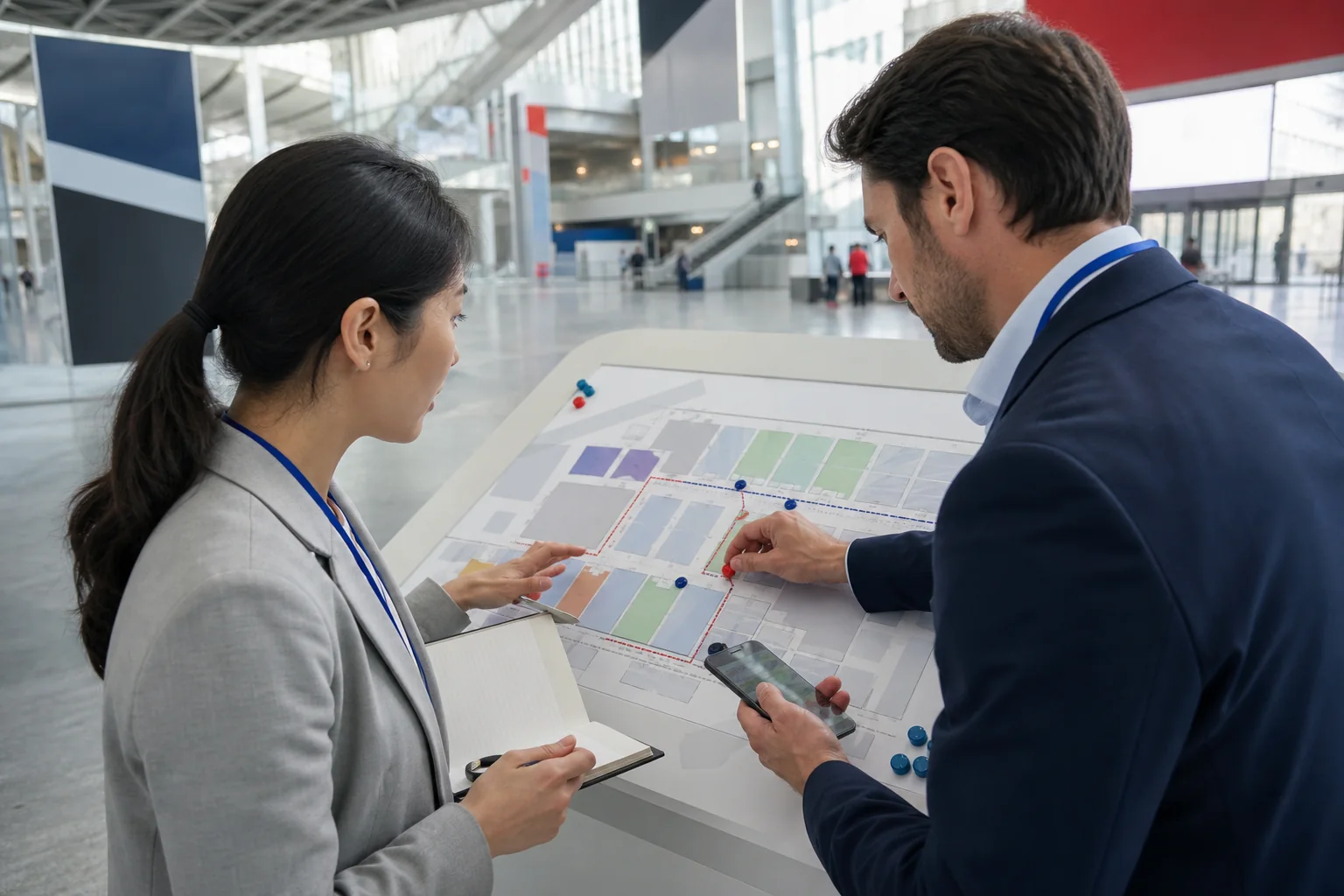
Cluster booths by area and importance. Put fixed A meetings first, add travel buffers, and create a morning and afternoon route rather than zigzagging across the complex. Save booth details offline and take a screenshot of the current official map. Assign each team member a role: meeting lead, technical reviewer, evidence recorder and timekeeper. A two-person team can combine roles but should still agree who owns the record.
Keep one open slot in each half day for a delayed meeting or a newly discovered supplier. Set a stop rule: if the exhibitor does not match the product, cannot identify the manufacturing entity, or refuses basic evidence, end politely and recover the time. Schedule a 45–60 minute evening review before dinner; memory degrades quickly when every booth looks similar.
Travel light but operationally ready: comfortable shoes, power bank, approved file-sharing method, phone storage, notebook, business cards, controlled product brief, compact measuring tool where permitted, labeled sample bags and a consent-aware photo process. Do not bring unsafe tools or photograph restricted products, people or documents without permission.
Use the same meeting sheet at every booth
The first fields identify the evidence: date and time, phase, hall and booth, exhibitor name, Chinese legal name if provided, contact, job title, website, product and sample reference. Then ask whether the company is the manufacturer, trading company, exporter or a combination. Record factory locations and which site would produce the proposed item. Do not convert an answer into a verified fact until documents and later checks support it.
The technical fields cover current models, material and component sources, tolerances, performance, customization limits, tooling, sample process, process controls, testing, traceability, packaging and common defects. The commercial fields cover MOQ by model and color, sample fees, tooling cost, price basis, capacity range, normal lead-time assumptions, payment proposal, export experience and quotation validity. Mark every number as supplier-stated until verified.
Finish with next actions, owner and deadline. Examples are: send business license, return a completed specification, provide an anonymized test-report example, quote three quantity breaks, confirm sample date, disclose subcontracted operations, or propose a factory-visit window. A promise without an owner and deadline is not a follow-up plan.

Questions that reveal capability instead of rehearsed sales answers
Ask the supplier to explain how the product is made, which operations occur at its own site, which are outsourced, what changes between a sample and mass production, and where defects most often occur. Ask to see two or three variants and explain the cost difference. A knowledgeable response links material, process, tolerance, inspection and failure mode; it does not merely repeat “high quality.”
For capacity, ask for the bottleneck process, normal shift pattern, seasonal loading, minimum economic batch and how a rush order affects other orders. Do not demand a dramatic capacity claim. You need the assumptions: product mix, line, yield, changeover, workdays and approved subcontractors. Later, compare those statements with a factory visit or independent verification.
For quality, ask who approves the first article, which characteristics are critical, what measuring equipment is used, how nonconforming material is segregated, how customer complaints enter corrective action, and what records follow a lot. The answers should connect to your own inspection plan and to independent inspection and quality control when risk justifies it.
Separate the booth identity from the legal supplier and factory
A booth name, English brand, salesperson’s email and bank beneficiary may refer to different entities. Ask for the full Chinese registered name and business-license copy for the proposed contracting party, plus the role of the manufacturer and exporter. Note any affiliated company before discussing a deposit. Later, compare contract, invoice, license, bank beneficiary and factory evidence.
Use the detailed method to verify a Chinese supplier. A live registration proves neither capacity nor quality, while a polished booth proves neither legal identity nor ownership of the production line. For a material order, supplier and factory verification can test identity, location, process and declared capabilities before funds or tooling are committed.
Red flags deserve questions, not instant accusations: a beneficiary unrelated to the seller, reluctance to provide the Chinese company name, inconsistent factory locations, product ranges too broad for one process, copied certificates, pressure for immediate payment, or refusal to allow a later visit. Document the explanation and independently verify it.
Control samples and evidence before they become anonymous
Give each sample a unique ID tied to the booth record. Photograph the overall item, label, packaging, critical details and the supplier representative only with permission. Record whether it is a standard showroom sample, a custom sample, a reference for appearance, or evidence of a claimed process. Never treat a display sample as the automatically approved mass-production standard.
For a paid or shipped sample, write the specification revision, cost, courier, declared value, destination, testing plan and ownership. The guide on ordering product samples from China explains how to compare and approve samples before a bulk order. Keep customs, battery, liquid, food, biological and dangerous-goods restrictions in mind before carrying or shipping anything.
Create a photo rule for the team. Capture only what the exhibitor permits; avoid other visitors, private screens, confidential drawings and restricted displays. Rename files that evening with supplier code, booth, product and sequence. Back them up to an access-controlled location so the evidence is not scattered across personal phones.

Request quotations that can actually be compared
Ask every shortlisted supplier to quote the same controlled brief and quantity breaks. Require currency, price validity, included packaging, tooling, sample treatment, taxes if relevant, Incoterms rule and precise named place, lead-time assumptions, payment proposal, carton dimensions and weights, and exclusions. A unit price without these inputs is not comparable.
Normalize the offers after the fair. Separate product, tooling, packaging, inland movement, export handling, main freight, insurance, duties, taxes, inspection, testing and expected defect or rework exposure. The guide to choose air or sea freight helps frame the transport decision, but current rates must come from real quotations for the shipment profile.
MOQ is also a structure, not a single number. Ask whether the minimum applies by order, model, color, component purchase or production run, and what changes if standard packaging or material is used. Do not trade away specification control merely to reach a smaller first order.
Score suppliers each evening while evidence is fresh
Use a weighted scorecard tied to the purchase risk. A practical model may cover product fit, technical understanding, process ownership, identity transparency, quality system, responsiveness, commercial fit, sample readiness, lead-time credibility and evidence completeness. Weight safety, compliance and critical capability more heavily than booth presentation or hospitality.
Attach confidence to every score: verified, document seen, supplier stated, inferred or unknown. A supplier can have a high preliminary fit score and still remain blocked because its legal identity or critical test evidence is unknown. Maintain a separate red-flag field that a weighted average cannot hide.
At the daily review, place suppliers into four states: advance, request evidence, reserve, or reject. Send a concise recap to advanced candidates so misunderstandings surface quickly. Do not announce a winner at the booth, sign an uncontrolled purchase order or pay a deposit simply because the team is tired and one conversation felt positive.
Use the gaps for selected factory visits, not sightseeing at random factories
A factory visit makes sense when the supplier fits the brief, the likely order justifies the effort, the production site can be identified, and the visit has written objectives. Confirm the legal and operational entity, address, host, product or process to be observed, photography rules, travel time and whether production will actually be running.
At the site, trace the proposed product from incoming material through storage, production, in-process control, final inspection, nonconforming segregation, packing and dispatch. Compare equipment, staffing and bottlenecks with booth claims. Review anonymized records where appropriate; do not demand another customer’s confidential data. Note outsourced operations and how they are controlled.
A guided tour is still supplier-provided evidence. Follow with registration checks, referenceable documents, sample testing and proportionate independent verification. If the factory cannot receive a visit during the trip, that is not automatic proof of a problem, but the alternative evidence and later verification should be planned before ordering.

Run a 48-hour and 10-day follow-up system
Within 48 hours, send each advanced supplier a separate recap: product code, requirements discussed, open questions, requested evidence, quotation format, sample action and deadline. Ask the supplier to correct errors. Do not send one mass email that exposes competitors or lets attachments drift between companies.
Within roughly ten business days, compare returned evidence, complete legal-entity checks, normalize quotations and choose which samples or visits proceed. The exact timing depends on complexity; the point is to keep a visible decision queue. Silence, vague attachments or repeated deadline slips are performance evidence and should affect the score.
Move the chosen candidate into a controlled purchase file: verified parties, specification, approved sample, quality plan, price and payment milestones, delivery term, change control, warranty, intellectual property and dispute advice. China Moshaver’s product sourcing support can help organize supplier comparison and the transition from discovery to verified procurement.
Risk controls the fair cannot replace
- Product compliance: determine destination-market rules and competent testing before relying on a certificate image.
- Legal identity: verify the proposed contracting party, exporter, factory and bank beneficiary.
- Specification: convert booth claims into controlled drawings, materials, performance and acceptance criteria.
- Quality: use samples, process evidence and a risk-based inspection or test plan.
- Commercial terms: normalize complete landed-cost inputs and protect changes to payment details.
- Capacity and timing: validate assumptions, seasonal load, subcontracting and production milestones.
- Intellectual property: disclose progressively and control drawings, molds, confidential information and excess production.
- Travel and registration: use official channels and recheck current instructions before departure.
The Canton Fair accelerates comparison because many suppliers and products are concentrated in one place. It does not remove the buyer’s duty to test whether the exact legal entity, factory, specification, evidence and commercial model can deliver the intended order.
Frequently asked questions
Which phase should I attend for the 140th Canton Fair?
Choose from the official product categories: Phase 1 for many electronics, industrial, vehicle, lighting, electrical, hardware and tool categories; Phase 2 for many housewares, gifts, decorations, building and furniture categories; Phase 3 for many toys, baby, fashion, textile, stationery, health, food, personal-care and pet categories. Confirm borderline products in the current exhibitor directory.
Can I register at the venue without pre-registration?
Current onsite options may exist, but the official fair encourages overseas buyers to use the Buyer Service System and prepare badge requirements in advance. Check the 140th-session portal and attendance guide for the latest collection locations, service hours and required original documents.
Does a Canton Fair invitation guarantee a Chinese visa?
No. It is supporting fair documentation, not a decision by an embassy, consulate or immigration authority. Confirm the current visa and entry requirements that apply to the traveler and allow time for corrections.
How many supplier meetings should I plan per day?
There is no universal number. A prepared team commonly gains more from a few deep priority meetings plus structured short comparisons than from dozens of card exchanges. Include walking, delays, meals, note capture and one flexible slot.
Should I place an order at the booth?
Usually the safer path is to preserve the offer, verify the party and factory, compare a controlled quotation, test or approve samples, agree the specification and quality plan, and review the contract before payment. A fair discount does not close those gaps.
Can a booth prove that the exhibitor owns a factory?
No. The booth is a discovery and meeting point. Ask for the Chinese legal identity and manufacturing role, then verify registration, location, capability and the relationship among seller, exporter, factory and bank beneficiary.
Official sources checked for this guide
- Official Canton Fair homepage for the 140th session — current phase dates, category overview and access to buyer services.
- Official phase and exhibit-category page — product mapping across the three phases.
- Official current fair information page — operating hours, complex address and organizer details.
- 2026 Attendance Guide for Overseas Buyers — official downloadable attendance guides in multiple languages.
- Official Guide on Invitation Application — Buyer Service System workflow for returning and first-time buyers.
- Official exhibitors, products and trade-matching page — current pre-trip search and matching route.
Operational note: This article was researched on 24 August 2026. Reconfirm all dates, categories, registration requirements, service locations and travel rules through the official sources before acting.



[…] Related guide: 140th Canton Fair buyer-planning guide […]